Thoughts on Leadership: Running with Mismatched Shoes

By Gino Blefari

As I kick off this new year, I participated in my regular Berkshire Hathaway Energy call. On Wednesday morning, I participated in the HomeServices of America Diversity MEETS monthly meeting superbly orchestrated by Teresa Palacios Smith, Chief Diversity, Equity & Inclusion Officer, where I had the honor to announce the recipient of the 2023 HomeServices Diversity Champion Award. This award was presented to Berkshire Hathaway HomeServices Georgia Properties – we celebrated and applauded their remarkable achievements and contributions toward advancing diversity and inclusion.  Heartfelt congratulations to them for being exemplary Diversity Champions! On Thursday morning, I also had the opportunity to speak to Intero’s Academy. During my talk, I shared the “6 Philosophies on Life and Business” to help make 2024 the best year yet.

Read more: Thoughts on Leadership: Running with Mismatched Shoes
  1. There will always be somebody who’s better.
  2. Fueling Growth: Discontent Drives Inspiration.
  3. Find mentors.
  4. Commit to do the work.
  5. Struggle is Necessary for Human Growth.
  6. Our season of change.

I’d like to offer this to all of our great companies – I’ll be in touch with our leadership teams to schedule in this new year.

As I gear up for a busy January, I couldn’t help but reminisce about an inspiring story that I’ve shared before and wanted to share again as a reminder.

A while back, a friend sent me a text asking, “Have you ever studied Jim Thorpe?” Intrigued, I revisited Thorpe’s remarkable journey, a story that has fascinated me since my childhood when I first read Bob Wheeler’s iconic book, “Jim Thorpe: The World’s Greatest Athlete.”

Jim Thorpe, a track and field star hailing from Oklahoma, is widely regarded as one of the greatest American athletes of the twentieth century. Born as Jacobus Franciscus Thorpe with the name Wa-Tho-Huk (“Bright Path”), he carried the heritage of Sac, Fox, and Potawatomi Indian bloodlines along with French and Irish ancestry.

There’s an iconic photo of Thorpe during the 1912 Olympics, standing on the track field with two different sneakers. This caught the attention of Wheeler, who embarked on a quest to uncover the truth behind the image.

As the 1912 Olympics commenced in Stockholm, Thorpe dominated the pentathlon, leading the 1,500-meter run by almost five seconds. The weather was relentless during the three-day decathlon. On the opening day, Thorpe raced down the track, completing the 100-meter dash in a record-breaking 11.2 seconds, a feat unmatched until 1948.

However, the story took an unexpected turn. On the second day of the decathlon, just minutes before the 1,500-meter race, Thorpe’s sneakers went missing (rumored to be stolen). Facing the challenge of being shoeless, Thorpe frantically sought help from his teammates. With one teammate offering an extra shoe that was too small and another shoe found in the garbage bin that was too large, Thorpe improvised.

Wearing one too-small shoe and another too-large, the odds were stacked against Thorpe. Yet, with unmatched resilience, he stood on the Olympic starting line, facing the world’s best decathletes. And what did he do? He won, completing the 1,500-meter run in 4 minutes, 40.1 seconds.

So what’s the message? Never give up. Despite the odds, despite the challenges, never give up. Take the shoes you’re given and run as fast as you can, just like Thorpe did at the Olympics.

As we step into 2024, let’s embrace the spirit of Jim Thorpe—facing challenges head-on, adapting to what comes our way, and running towards success with unwavering determination.

Here’s to a remarkable and resilient 2024!

Thoughts on Leadership: Compassion & Gratitude

By Gino Blefari

This week my travels find me starting Monday at my home office, conducting my usual WIG calls, and participating in the early morning Berkshire Hathaway Energy call. On Tuesday, I traveled to Orange County to attend the National Association of REALTORS® Annual Conference & Expo and that night, the RISMedia Power Broker Reception Dinner. On Wednesday, I had business meetings in Beverly Hills, California then traveled home in the evening. Today, I spent the morning presenting and participating in the virtual Intero Joint Leadership Meeting then sat down to write this post to you.

If you’re following along with Thoughts on Leadership this month, you’ll know that November is ‘Gratitude Month,’ when all posts explore various life-changing, business-building, leadership-enriching aspects of gratitude. In response to last week’s post about positive self-talk, I received an email from Micheline Vargas, REALTOR®/sales associate with Berkshire Hathaway HomeServices California Properties. In addition to being a real estate professional, Micheline is also a Doctor of Public Health – Preventative Care. As Micheline explained in her email, she recently gave a talk at the California Properties’ Pasadena office about the benefits of gratitude and compassion, where she used research findings to outline how gratitude and compassion “can improve emotional, physical and social well-being.” Her course description explained that “people [who] practice gratitude and compassion experience greater social connection and are more altruistic. They have increased hope, optimism, and happiness. Research shows happy people have greater productivity, improved work quality, and even make more money. Practicing gratitude and compassion is also associated with reduced stress, depression, chronic pain, and cardiovascular disease.”

Read more: Thoughts on Leadership: Compassion & Gratitude

Talk about serendipitous timing!

Because we’re focused on gratitude this month, I thought we too could take a stroll through the available research and resources on this topic as it relates to compassion and happiness, with due credit – and utmost gratitude – to Micheline for inspiring today’s post.

Before we dive into the research, let’s first draw a line between gratitude and happiness. In a 2021 article published by the Harvard Medical School, experts explained that psychological research consistently and strongly links gratitude with greater happiness: “Gratitude helps people feel more positive emotions, relish good experiences, improve their health, deal with adversity, and build strong relationships.”

Now that we see how gratitude is tied to increased happiness, let’s discuss what happens when you feel really happy.

William Shakespeare once wrote: “A merry heart goes all day. Your sad tires in a mile-a.”

In a 2005 study, “The Benefits of Frequent Positive Affect: Does Happiness Lead to Success?” published by the American Psychological Association, researchers found that those who experience positive emotions – or to use Shakespeare’s words, those who are merry – tend to not only be more successful than those who experience negative emotions but also are more accomplished across “multiple life domains.” Why? The study cited that a positive mood helps people to “think, feel and act in ways that promote both resource building and involvement with approach goals.”

In other words, positive, compassionate, and happy people believe they have the tools, skills, relationships, and knowledge necessary to achieve anything. They also believe, according to the study, that all these things can be expanded to further new goals and combat future challenges.

As for gratitude, a 2022 article published by Mayo Clinic Health System reported that the expression of gratitude doesn’t just have positive mental benefits; it has positive physical benefits, too. “Studies have shown that feeling thankful can improve sleep, mood, and immunity. Gratitude can decrease depression, anxiety, difficulties with chronic pain and risk of disease,” the authors explained, likening gratitude to a kind of happy pill that allows your brain to appreciate the good in your life rather than harp on the negative. (In Micheline’s presentation, she notes that keeping a gratitude journal has been shown to improve sleep duration by an impressive 10%.)

If you’re reading all this research and thinking, ‘Makes perfect sense, Gino, but how can I express more gratitude in my life to reap these kinds of psychological and physical rewards?’

Here are a few places to get you started:

  • Keep a gratitude journal and add the practice of writing in it to your everyday routine (you can even use my own Gratitude Journal by clicking here).
  • Write handwritten thank you notes to people in your life and mail them out or deliver them each week.
  • Thank someone mentally whenever you’re reminded of the joy and happiness they’ve brought to your life.
  • Meditate or start a practice of meditation, which puts your brain in the present moment and allows it to observe what’s happening without judgment.
  • Volunteer your time for a worthy cause dedicated to helping the lives of others (expect to experience the classic “helper’s high” feeling of elation when you do this).
  • Put your phone away on your next walk or outing, and observe the sights, sounds and smells all around you.

So, what’s the message? Joy may be the simplest form of gratitude but joy that’s shared becomes compassion, and a joyful, compassionate, grateful person is the most wonderful leader of all.

Thoughts on Leadership: In Gratitude for Positive Self-Talk

By Gino Blefari

“You are everything that is, your thoughts, your life, your dreams come true. You are everything you choose to be. You are as unlimited as the endless universe.” – Dr. Shad Helmstetter

This week my travels find me starting Monday from my home office, conducting my typical WIG calls. On Tuesday, I participated in the early morning Berkshire Hathaway Energy call then traveled to New Orleans for Wednesday’s creative presentation by Corporate Magic for the Berkshire Hathaway HomeServices Sales Convention 2024. Wednesday afternoon, I traveled home and this morning, I sat down to write this post to you.

Read more: Thoughts on Leadership: In Gratitude for Positive Self-Talk

If you read last week’s post, you’ll know we’ve officially declared November “Gratitude Month” here in Thoughts on Leadership land, a time to talk all about the ways gratitude can positively transform your business and life.

One important element of gratitude is remembering that the way you talk to yourself can have a huge impact on your mindset.

In fact, you can test the efficacy of your self-talk with a single question. Ask yourself this: “Is the way I use language programming me for success or failure?”

Your answer is your barometer for how positive or negative your self-talk is right now.

When it comes to self-talk, one of the preeminent authorities on the topic is Dr. Shad Helmstetter, founder of The Self-Talk Institute, the Self-Talk Plus App and author of more than 25 books about self-talk. (For a fantastic read, I suggest checking out Dr. Helmstetter’s best-seller, What to Say When You Talk to Yourself.) Prior to his work in the field of human behavior, Dr. Helmstetter was a foreign language interpreter for the U.S. government. It was during this time that he realized everyone thinks and speaks with their own “internal language of success or failure.” He says, “I developed a hypothesis that with the right self-talk, we could actually train our brain to think in the positive, just like learning a new language.”

After extensive research, Dr. Helmstetter’s studies found that the hypothesis was correct. One important way to retrain your self-talk is through gratitude. “Gratitude is the conscious recognition of someone else, or of the world itself, sharing its blessings with us,” Dr. Helmstetter described in an interview for Authority Magazine. “Gratitude is one of the few human emotions that can be experienced in the positive.”

Dr. Helmstetter says that one reason we don’t feel gratitude is because our negative self-talk “literally rewires gratitude out of our brains.”

In scientific terms, those who think in the negative wire their brain’s right prefrontal cortex to be stronger, he explained. Why is that so bad? Dr. Helmstetter says that the right prefrontal cortex is the area of the brain that causes us to feel afraid, to hide or to flee, and he says that people who think negatively all the time grow more neural networks and connections in the part of the brain that turns off gratitude. Conversely, those who feel gratitude and think positively build up the neural connections in the left prefrontal cortex, which is the area that helps find solutions and brings about a sense of peacefulness. If gratitude had a home in our minds, it would be in this left prefrontal cortex, according to Dr. Helmstetter, and when you think positive thoughts, this part of the brain is subsequently strengthened.

You might be reading all this and thinking, ‘OK, I want to strengthen my left prefrontal cortex, feel more gratitude and think more positively but how do I change the language of the self-talk in my brain?’

Well, you could stop yourself from what many call “doomscrolling,” or the act of picking up your phone and taking in a torrent of negative news and content. Psychologist Dr. Susan Albers says the reason many people with negative mindsets doomscroll is because for them, it’s comforting to seek out information that confirms any negative feelings they might be experiencing.

So, you could stop opening your phone and doomscrolling the internet at night. You could also repeat a list of positive affirmations in the morning. Remember, great leaders believe anything is possible because they have repeated that idea over and over again in their heads. It’s a simple idea but one that is often overlooked.

There is real strength to be found in repetition. Legendary sales trainer and my first real estate mentor Tom Hopkins once said, “Repeat anything often enough and it will start to become you.”

When I teach my course on mindset routine, I talk about the nonconscious mind being servile, which means it sets no goals of its own. It doesn’t judge the merit or the value of the request; it just tries to carry out the given order.

Denis Waitley, author of “The Psychology of Winning,” said: “When you talk to yourself, you should be your best coach and not your worst critic.” Waitley studied the effect of psycholinguistics on Olympic athletes and their coaches, and how autogenic training allowed their bodies to respond to what they said in their minds. Self-talk like: “My heart rate is slow and regular … my breathing is relaxed and effortless …”

When these athletes said these things in their minds, their bodies responded. Through repetition and the way you speak to yourself, Waitley explained, the body reacts to what you’re saying and does just that.

So, what’s the message? Brian Tracy (quoting the legendary Earl Nightingale from The Greatest Secret) says the greatest discovery in human history is that you become what you think about most of the time, which is one of the reasons why the more you study leaders, the more likely you are to become an effective leader. Self-talk, at its very essence, is what we say to ourselves all day long and how we say it. I’ll end with this anecdote from Johnny Bench, fourteen-time MLB All-Star and a two-time National League Most Valuable Player: “In the second grade, they asked us what we wanted to be. I said I wanted to be a ball player and they laughed. In the eighth grade, they asked the same question, and I said a ball player and they laughed a little more. By the eleventh grade, no one was laughing.”

Thoughts on Leadership: Fourth Quarter Positive Habits and Time Management

By Gino Blefari

This week finds me traveling back on Saturday afternoon from AREAA and meetings in Chicago, then starting Monday conducting my typical WIG calls with CEOs. On Tuesday, I participated in the early morning Berkshire Hathaway Energy call and then the monthly HomeServices of America leadership meeting. Yesterday, I had two succession calls, and today, I sat down in the morning to write this post to you.

We’ve been talking a lot about business planning and scheduling, and how the best way to ensure a strong 2024 is to do those things now. As you’ve heard me say before, real estate operates on a 90-day cycle; so much of what you do in October and November will pay out at the beginning of next year. It’s also why I say this is the perfect time to reinforce positive habits and eliminate negative ones. The time to start changing for the new year isn’t when you make resolutions for January 1 … it’s now.

Read more: Thoughts on Leadership: Fourth Quarter Positive Habits and Time Management

My own morning routine has changed for the better lately. After walking my dog June, I go straight to doing cardio on a power plate that fits right in my office, then spend 30 minutes in an infrared dry sauna before moving to a steam sauna with eucalyptus and lavender, which clears out my sinuses.

And instilling new, positive habits goes hand-in-hand with time management. As Atomic Habits author James Clear said: “Good habits make time your ally. Bad habits make time your enemy.”

It’s true. While in Chicago last week, I had the honor of presenting my “76 Points On Time Management And Efficient Operations” to the Berkshire Hathaway HomeServices Chicago team, and here are 10 takeaways from that talk:

  1. Time management and forming habits is as much about discipline and daily practice as it is about identifying the routines that will give you an edge. Once you decide on the habits you’d like to implement, your next step is committing to the daily practice of those habits, so they become part of your subconscious and a natural element of your everyday life.
  2. Pick four positive time management strategies to focus on each month; once you’ve got those down, move onto the next four in the following month. As I told the team in Chicago, don’t try to do all 76 at one time. If you start this process now, by picking four each month, you should have about 16 new and positive time management strategies incorporated into your routine by the time the new year begins.
  3. Energy is paramount. The secret to time management is that productivity isn’t about time; it’s about energy and focus. There are 1,440 minutes in a day; invest your time wisely to make the most of every moment.
  4. The task that will have the single biggest impact on your time management is prioritization. Determine and prioritize your Most Important Task each day.
  5. Don’t be afraid to say “no” to things that don’t fit your goals or schedule. Research has found that people who say “no” in response to requests for their time tend to be happier and have more energy.
  6. One quick way to improve email management (and thus time management, because how much time do we spend on email?) is to implement a policy of descriptive subject lines. This way, you can know immediately what you’re addressing in that email. Also, when the subject of the email changes, the subject line of that email should change. I abide by the “touch it once rule” for email management: answer it, delete it, or file it.
  7. Each day, list the seven most important things you need to do, noting the time it’ll take to complete each task, and get those seven things done in the time allotted. Put the most important task first. This simple step will give you a tremendous sense of control and accomplishment. According to the Law of Single Handling, the ability to start and complete your most important task determines your productivity more than any other skill. And as for the timeline, the reason why you put timelines next to each of the seven things is Parkinson’s law, which says work expands or contracts to fit the time allotted; that’s why you always want to do everything in the time it should take. You can put buffers in your schedule, but don’t pad the time it takes to do any given task.
  8. Avoid Rocking Chair Syndrome, which is movement without going anywhere at all. Mental toughness is required for real progress, and it means doing what you’re supposed to do even on the days you don’t feel like doing it. Discipline is the ability to make and keep promises to yourself, and it’ll determine your success. Remember, the pain of discipline weighs ounces, the pain of regret weighs tons. Your destiny and professional growth are your responsibility, not anyone else’s.
  9. When it comes to time management and being effective, the most important thing you can do is to follow your schedule and never make a commitment of your time without checking your schedule first. This way you won’t miss any meetings, or anything you’re asked to do. You also won’t make a commitment of your time without checking your schedule first.
  10. Have a goal board in your office. List the goals you have set and the things you have accomplished. They keep you on track. A strong accountability partner will also keep you on track with your commitments and goals. Record your numbers daily, at the same time each day. Allow 15 minutes at the end of your day to complete this task. As the saying goes: When performance is measured, performance improves. When performance is measured and reported back, the rate of improvement accelerates.

In Og Mandino’s The Greatest Salesman in the World, he offers 10 scrolls that are designed to instruct you how to take bad habits and replace them with good habits. You may all recall the famous saying: When you keep your thoughts positive, your thoughts become your words, your words become your actions, your actions become your habits and your habits become your destiny.

If you’re looking for more inspiration to begin better habit-forming practices now, here’s a good reading list to get you started:

  • The Slight Edge by Jeff Olson
  • Atomic Habits by James Clear
  • The Greatest Salesman in the World by Og Mandino
  • The Year of Yes by Shonda Rhimes
  • The Richest Man in Babylon by George S. Clason
  • Think and Grow Rich by Napoleon Hill
  • The Score Takes Care of Itself by Bill Walsh

So, what’s the message? There’s no better time than today to take a bad habit and turn it into a good one, and I’ve been endlessly inspired by Og Mandino’s teachings, and was fortunate enough to have him as a friend and mentor. Thank you, Og Mandino, for always reminding me that my life goal should not be to win or be number 1; it’s to be the best version of myself. As another mentor of mine Bill Walsh says, if you do that “the score takes care of itself.”

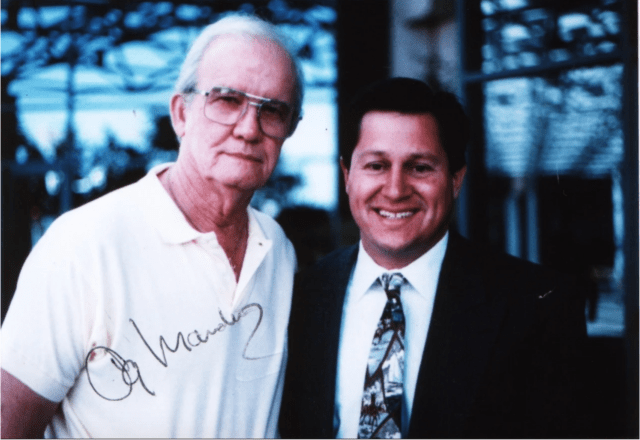
Pictured: Gino and Og Mandino circa 1986.

Thoughts on Leadership: Lessons from Mr. Irrelevant

By Gino Blefari

This week my travels find me heading to New Orleans on Monday for the Berkshire Hathaway HomeServices Marketing Forum, where the following day I delivered a presentation about the win-against-all-odds Kentucky Derby winner “Rich Strike.” On Wednesday, I traveled by car with Roberts Brothers President Teresa Williamson to Mobile, Alabama for a visit with the Roberts Brothers team. Today, I met with Roberts Brothers during their all-company sales meeting (with a Q&A led by Teresa) then hopped on a flight to Chicago for a visit with the Berkshire Hathaway HomeServices Chicago team. Tomorrow, after spending time with the Chicago team, I’ll attend an Asian Real Estate Association of America (AREAA) lunch followed by the AREAA Gala in the evening. Of course, in between meetings, I sat down to write this post to you.

Last week, I received an email from Eric Webster, general manager at Berkshire Hathaway HomeServices First Realty, in response to the weekly Thoughts on Leadership detailing lessons learned from the NFL. He wrote: “Good morning, Gino. You and I are cheering for the same guy for maybe slightly different reasons. I am a fan of [San Francisco 49ers Quarterback] Brock Purdy from his days at Iowa State.”

Read more: Thoughts on Leadership: Lessons from Mr. Irrelevant

Eric said he’d been thinking about Purdy lately as he’s been in the news for near-flawless performances during games this season, helping to lead the 49ers to a 5-0 start. (It’s certainly made my Sundays a lot more enjoyable!) In his email, Eric posed an interesting point to consider: “I’ve been wondering why he is so good today – but was only ‘good’ at Iowa State University.”

When Purdy played at Iowa State University, he was a solid player, but his team didn’t win a national championship. In the 2022 NFL Draft, he was chosen 262nd, the very last player selected, historically deemed “Mr. Irrelevant.” (He was even celebrated during “Irrelevant Week,” a charity event held each year in Newport Beach – just a few minutes’ drive away from the Berkshire Hathaway HomeServices headquarters – to celebrate the last-picked player in the NFL draft.)

Today, Purdy is the ultimate come-from-behind underdog story, very much like the story of Rich Strike I told days earlier at Marketing Forum in New Orleans. From beginning his NFL career as Mr. Irrelevant, Purdy is today starting quarterback for a so-far undefeated 49ers team. He threw four touchdown passes in Sunday’s game against the Cowboys. He has fourteen consecutive regular season wins under his belt, dating back to last season. And to echo our earlier question: Why? How did a player picked last in the NFL draft turn into such a standout?

Well, there are many reasons for Purdy’s productivity and high-performance, and each one proves a lesson in both leadership and the establishment of a mindset that embraces perpetual improvement:

  • Trust. Purdy is implicitly trusted by his teammates and 49ers Head Coach Kyle Shanahan; it’s a trust he’s earned through consistent results since taking over the starting quarterback position during Week 13 last NFL season. Shanahan says Purdy’s been “extremely consistent in practice since he’s been here, and he’s been the same in games. What you see is what we see and it’s what you feel.” Trust is earned, and trust is felt. Trust allows teams to take risks and push themselves harder on the path toward reaching their highest potential, knowing every member of the team supports the whole.
  • Progress. Some might say Purdy is the byproduct of an excellent team, a quarterback surrounded by a tough offense line that’s coached by some of the best offensive strategists in the nation. But while critics will tell you it’s only a matter of time before Purdy’s “great” turns to “not so good,” the stats are clear: Purdy keeps getting better. His time before passing improved from 2.84 seconds in 2022 to 2.56 seconds so far this season. He’s also bringing the ball farther down the field, with 7.2 air yards per attempt, up 0.2 yards from last year. Purdy’s 95.2% completion rate in Sunday’s game against the Cowboys is the best by any passer in 49ers history, and 48.2% of Purdy’s pass attempts gain a first down or touchdown, which is the highest percentage in the NFL right now. In leadership, a commitment to evolve and innovate is everything.
  • Dedication. As 49ers Left Guard Aaron Banks told ESPN: “[Purdy] is a dude who comes in and studies his film, studies his craft and makes sure he’s getting better week by week.” In leadership, a dedicated leader who is set on improvement is far more important than a leader who is complacent, even if they’re at the top of their game. Remember, once you think you know it all, your slide to mediocrity has already begun.
  • Chemistry. In Eric’s email, he said: “Something happened to Brock. He is on the right team at the right time, and they are really having fun together.” This is a true example of chemistry at play. In sports, chemistry is everything. You win or lose based on the chemistry of your leaders and your team. The same applies to business; a good leader not only understands their team’s chemistry but can also utilize it to effectively accomplish every Wildly Important Goal.

So, what’s the message? An underdog like Mr. Irrelevant has nothing to lose and everything to gain, which is the perfect recipe for success. 

Thoughts on Leadership: How’s That Business Plan Going?

By Gino Blefari

This week my travels find me starting Monday in my home office, conducting WIG calls throughout the day. On Tuesday, I participated in the early morning Berkshire Hathaway Energy call then presented a virtual leadership session for the Chalk Digital team. On Wednesday, I attended the HomeServices of America Diversity MEETS monthly meeting, and today, I sat down to write this post to you as I battle a strong cold that’s been lingering all week.

Last week, we rang in the real estate new year (read more about that here), and this week, I want to dive deeper into ways you can prepare and plan for a strong 2024. Ideally, you should complete your business plan in October; but if you haven’t started yet, you can download the Business Planning Essentials here.

Read more: Thoughts on Leadership: How’s That Business Plan Going?

Why plan in October? As I mentioned in last week’s post, real estate works on a 90-day cycle. What you do today will pay off three months from now, and concurrently, what you don’t do today will cause suffering and headache three months down the road.

Planning a full 90 days before the start of the New Year means that as soon as January 1 rolls around, you’ll already be running when you hit the ground. A business plan allows you to prepare for expected and unexpected challenges. It ensures the busy holiday season won’t stop your momentum in 2024. As the famous Ben Franklin quote goes: “A failure to plan is a plan to fail.” (Heard that one before, JT?)

A big part of business planning is planning your schedule. Once you plan your schedule, staying on your schedule is by far the most important thing you can do.

This weekend, aim to schedule out every day for the remainder of the year, including every single day off, and every day you’ll work for the rest of 2023. Make sure on those days you work, you work. On your workdays, follow your schedule, do your prospecting, and complete every task that will turn into business for you.

Then, from now to the end of the year and if you can carry it throughout the upcoming year, review your schedule for your upcoming day the night before. Every week, review your weekly schedule the Sunday before. And every month, review your monthly schedule the day before a new month begins. Having a schedule, and more importantly following your schedule, will have the biggest impact on your success.

Plus, part of business planning and scheduling naturally involves articulating your goals, and writing down goals has been proven to positively correlate to a person’s likelihood of achieving them.

In 1953, Harvard conducted a now-famous study on goal setting. Researchers asked Harvard MBA students about their goals. Here were their responses: 3% said they had clear, written goals; 13% said they had goals, but they were not written down; and 84% said they did not have goals at all. Ten years later, the study examined the success of its participants and found that the 13% who had non-written goals earned on average two times as much as the 84% of people who did not have goals. Most impressively, the study revealed that the 3% who had written goals outperformed everyone in the study by earning ten times as much as the other 97% of participants combined.

So, what’s the message? Scheduling helps you meet your goals, and goals are key to success.  Plan and schedule yourself out now, so when everyone else is working or scrambling to business-plan over the holidays, you’ll be ahead of the game and on your way to success.

Thoughts on Leadership: Leadership Lessons from the NFL

By Gino Blefari

This week my travels find me on the Big Island of Hawai’i, attending the 2023 Berkshire Hathaway HomeServices Summit Conference. It’s been an incredible few days of learning and growth, and the perfect place to kick off the official start of the football season.

Over the years, I’ve spent a lot of time studying the connection between sports and leadership, and specifically football and leadership, drawing inspiration from sports icons like my buddies Dwight “The Catch” Clark, Ronnie Lott, Steve Mariucci, Brent Jones, and Johnnie Johnson, Allan Dalton and Jimmy Burgess, along with Eddie DeBartolo, Bill Walsh, Joe Montana and Tom Brady.

Read more: Thoughts on Leadership: Leadership Lessons from the NFL

During Summit, I met Jimmy Burgess, CEO of Berkshire Hathaway HomeServices Beach Properties of Florida, (who I mistakenly referred to as Jimmy Buffett during my Tuesday morning Summit talk) every morning at 5 a.m. at the hotel pool, where we’d spend an hour treading water and talking about leadership. During one of these workouts, Jimmy told me: “Gino, leaders are just like coaches, because the best leaders bring out the best in their teams.”

That got me thinking about leadership lessons we could learn from football. The NFL is more than just a powerhouse athletic competition. It’s a complex institution that showcases teamwork, strategy, and leadership both on and off the field. Whether you’re a die-hard football fan or interested in the dynamics of effective leadership, the NFL offers a multitude of lessons for us all. Let’s dive into these insights.

  • The Importance of Teamwork: Football is a team sport where individual brilliance can shine, but victories are achieved collectively. Leadership isn’t a solo endeavor; it requires collaboration and relies on the strengths of each team member to win a game and a championship.
  • Adaptability and Change: In the NFL, game plans can change on the fly, and coaches must adapt to the opposing team’s strategies as they adjust. Similarly, leaders must be prepared to adjust their strategies when circumstances change. Think of the halftime adjustments the best coaches make to change the outcome of the game.
  • Preparation and Planning: From hours of film review to grueling practice sessions and NFL training camp, success on game day is a result of the exhaustive preparations that happen behind the scenes. Miami Dolphins Head Coach Mike McDaniel famously leaves his house at 2:24 a.m. for work every day, getting to the office a little before 3 a.m. It’s a habit acquired after working under former Houston Texans Head Coach Gary Kubiak, who called McDaniel twice at 6 a.m. without an answer. (McDaniel was later fired from the job specifically for being late twice). The experience taught McDaniel a harsh lesson about priorities, preparation, and planning. “You’re chasing the best version of yourself,” he told ESPN when describing his early-morning commute. “This part of the day is so unique because everything is in front of you.” Being prepared can make the difference between success and failure.
  • Resilience in the Face of Adversity: Setbacks, like injuries or game losses, are part of the NFL. Just look at the awful, season-ending injury of New York Jets Quarterback Aaron Rodgers after just four snaps into his first game with the team. However, teams regroup and adjust and return with renewed vigor. Leaders, too, will face setbacks but must demonstrate resilience and perseverance.
  • Continuous Learning: The best NFL coaches and players are always studying, learning, and refining their techniques. Tom Brady’s former teammate, Tight End Rob Gronkowski, estimated that Brady watched 40 hours of film each week. Bill Walsh talked about his return to coaching college football when he’d get five hours of sleep on a couch in his office. Leadership requires a commitment to perpetual improvement. It’s about lifelong learning and a willingness to adapt based on new knowledge you acquire every day.
  • Effective Communication: Clear communication between coaches, players, and staff is vital for successful plays and overall team dynamics. Similarly, effective leadership requires transparent and open communication.
  • Accountability: Players and coaches must take responsibility for their actions on and off the field. Great leaders hold themselves and their teams accountable, recognizing that fosters trust and integrity.
  • Diversity and Inclusion: The NFL comprises players from diverse backgrounds, and the synergy of this diversity can be a driving force behind a team’s success. In leadership, promoting diversity and inclusion can lead to innovative solutions and a broader perspective.
  • An Example for Others to Follow: Captains and veteran players often set the tone for the team’s work ethic and values. As a leader, embodying the values and work ethic you wish to see in your team is crucial.
  • Work-Life Balance: While the NFL demands rigorous training, players also understand the importance of recovery and personal time. Leaders should recognize the importance of balance for sustained performance and mental well-being.
  • Long-Term Vision: The best teams in the NFL don’t just plan for the current season but also have a vision for the future. Similarly, effective leaders set short-term goals with a long-term vision in mind.

So, what’s the message? The thrills of the NFL aren’t limited to spectacular touchdowns or nail-biting finishes. They extend into the realm of leadership, strategy, and team dynamics. The league, with its diverse set of challenges and successes, offers a playbook of leadership lessons that can be applied far beyond the football field. Whether you’re leading a corporate team, a community initiative, or any other endeavor, tapping into these insights can pave the way for both individual and collective success.

Thoughts on Leadership: Leadership Lessons from Jimmy Buffett

By Gino Blefari

This week my travels find me starting Tuesday with an early morning Berkshire Hathaway Energy call, then traveling to Washington, D.C. for RISMedia’s CEO & Leadership Exchange 2023. On Wednesday, I delivered a presentation for the CEO & Leadership Exchange crowd and today, I’m traveling home to prepare for my flight to Hawai’i to attend the Berkshire Hathaway HomeServices Summit Conference. Of course, while looking out my airplane window, I also spent some time writing this post to you.

Last Friday when I was getting my hair cut, I sat in the chair and asked my stylist: “Hey, would you mind if I play a Jimmy Buffett song right now?”

Read more: Thoughts on Leadership: Leadership Lessons from Jimmy Buffett

I explained that I always think of Jimmy Buffett on the Friday before Labor Day because of the song “Come Monday” and its opening line: “I was heading up to San Francisco for the Labor Day Weekend show …”

“Go for it,” he said. “I’ve actually never listened to Jimmy Buffett before.”

The next day, I got a text from him early in the morning: “Did you hear? I can’t believe it. Jimmy Buffett died. We were just talking about him yesterday.”

My first thought upon hearing the news (after an initial wave of sadness that the musical “great” had passed on) was that I’m glad I played a little tribute to Buffett, sharing his music with at least one person who didn’t know who he was.

Jimmy was an iconic musician and entrepreneur, best known for hits like “Margaritaville” and his devoted fans called “Parrotheads.” But beneath the casual beachcomber persona was a smart businessman and leader with decades of experience. Let’s dive into some leadership lessons from Jimmy Buffett:

Pursue your passion authentically. Jimmy’s music embodies his love for the beach, relaxation, and the sea. His authentic representation of his passions has endeared him to millions. Yet his sound was unique, unable to be labeled pop or country or rock in the traditional sense. He once said of his music: “They say I’m uncategorized; and to that I say, ‘Thank you.’” As leaders, it’s essential to follow your passion, wherever that may lead.

Adapt and pivot. Jimmy’s career didn’t take off immediately. In fact, his album “Down to Earth” sold just 324 copies and “Margaritaville” (released in 1977) was his only single to reach the pop Top Ten. Early in Jimmy’s career, he made shifts in his musical style and brand before finding his niche. Great leaders understand that adaptability is vital.

Collaborate and network. Over the years, Jimmy collaborated with various artists, which expanded his reach and appeal. Leaders should recognize the power of collaboration and networking, as it can lead to unexpected and fruitful opportunities.

Balance work and play. While Jimmy’s brand revolves around relaxation and beach life, it doesn’t mean he shied away from hard work. Instead, he mastered the art of balancing work with relaxation. Leaders should find this balance to ensure sustained productivity without burnout.

Prioritize sustainability. Jimmy’s advocacy for marine conservation and his efforts towards environmental sustainability underscored his forward-thinking leadership. Today’s leaders must recognize the importance of sustainable practices for long-term growth and the well-being of our planet.

Diversify your portfolio. Jimmy was not only a prolific singer/songwriter but also an avid sailor, accomplished entrepreneur (with his Margaritaville resorts, restaurants and merchandise) and a best-selling author. Leaders should look for opportunities to diversify, thereby minimizing risks and maximizing growth potentials.

Engage and cultivate your community. In 1985, coincidentally the same year when Jimmy opened his first Margaritaville location, bassist Timothy B. Schmit coined the phrase “Parrotheads” to describe Jimmy’s fans. And the name has stuck ever since, with Jimmy’s “Parrotheads” serving as a testament to his ability to create and nurture a community. As leaders, the emphasis shouldn’t just be on the product or service but on building and sustaining a dedicated community around the brand.

Make the most of whatever comes your way. Time and time again, Jimmy combatted challenges with good-natured humor and a well-worded pun. For example, he was an avid pilot and would typically fly himself to his shows. In 1996, Jimmy was flying one of his planes, Hemisphere Dancer, with Bono of U2, Island Records Founder Chris Blackwell, his wife and two daughters, when the plane was shot at by the Jamaican police. They later admitted opening fire on the musician was a “case of mistaken identity,” but the entire incident inspired Jimmy to write “Jamaica Mistaica,” turning a serious situation into a catchy, laid-back song.

So, what’s the message? When I arrived at the Washington Dulles airport this morning, I was reminded of Jimmy yet again as I read the departure signs and thought about his classic lyric “Reading departure signs in some big airport …” (See below for the lyrics to my favorite Jimmy Buffett song, “Changes in Latitudes, Changes in Attitudes,” which showcases that Adapt and Pivot lesson; and if you’re feeling really inspired, click on the link to give it a listen.) Whenever I’m feeling down and disappointed from a mishap, I play this song and specifically, recite my favorite lyric, so let’s end this post with my all-time favorite Jimmy Buffett line: “Oh, yesterday’s over my shoulder, so I can’t look back for too long. There’s just too much to see waiting in front of me and I know that I just can’t go wrong.”

Changes in Latitudes, Changes in Attitudes

Song by Jimmy Buffett

I took off for a weekend last month just to try and recall the whole year

All of the faces and all of the places wonderin’ where they all disappeared

I didn’t ponder the question too long, I was hungry and went out for a bite

Ran into a chum with a bottle of rum and we wound up drinkin’ all night

It’s those changes in latitudes, changes in attitudes

Nothing remains quite the same

With all of our running and all of our cunning

If we couldn’t laugh we would all go insane

Reading departure signs in some big airport reminds me of the places I’ve been

Visions of good times that brought so much pleasure makes me want to go back again

If it suddenly ended tomorrow I could somehow adjust to the fall

Good times and riches and son-of-a-b!tch$s I’ve seen more than I can recall

These changes in latitudes, changes in attitudes

Nothing remains quite the same

Through all of the islands and all of the highlands

If we couldn’t laugh we would all go insane

I think about Paris when I’m high on red wine I wish I could jump on a plane

So many nights I just dream of the ocean, god I wish I was sailin’ again

Oh, yesterday’s over my shoulder, so I can’t look back for too long

There’s just too much to see waiting in front of me and I know that I just can’t go wrong

With these changes in latitudes, changes in attitudes

Nothing remains quite the same

With all of my running and all of my cunning

If I couldn’t laugh I just would go insane

If we couldn’t laugh we just would go insane

If we weren’t all crazy we would go insane

Listen to the song on YouTube here.

Thoughts on Leadership: Lessons from Gary Koch

By Gino Blefari

This week my travels find me taking the week off to spend time with my family. It’s an opportunity to recharge before finishing out the year strong with our many HomeServices companies, leaders, and teams.

A few weeks ago, I wrote about leadership lessons from Steph Curry, including his passion for golf, and in response, received an email from Sue Behl with Berkshire Hathaway HomeServices Florida Properties Group whose husband was a caddie for PGA professional golfer and longtime commentator Gary Koch. Koch also happens to be the 2023 recipient of the PGA TOUR’s Payne Stewart Award, which will be presented Tuesday, Aug. 22 during the Payne Stewart Award Ceremony.

Read more: Thoughts on Leadership: Lessons from Gary Koch

“[Koch is] an awesome man who truly has earned it,” Sue wrote in her email, and because I couldn’t agree more, I wanted to showcase leadership lessons from Koch for today’s post. (Thank you, Sue, for your email. It’s always fun when readers respond to a Thoughts on Leadership post with ideas and inspiration!)

In response to Koch’s upcoming award, PGA TOUR Commissioner Jay Monahan said: “For someone who spent more than three decades telling the PGA TOUR’s story to the masses, at the heart of [Koch’s] character is the desire to usher the game forward through his charitable work. That’s what would make Payne smile: A passion and love for sharing the game with the world while looking after the next generation.”

Koch’s amateur golf career began in 1969 when he won the Florida Open at 16 years old. The next year, he won the U.S. Junior Amateur before heading to Gainesville, Florida to play golf at the University of Florida. According to the PGA, Koch is a four-time All American with 10 collegiate titles. He also helped the University of Florida Gators claim the 1973 NCAA Championship.

Koch officially joined the PGA TOUR in 1976 and played 15 seasons, collecting six PGA TOUR victories, including a famous win at the 1984 Arnold Palmer Invitational. After playing golf, he spent the next 33 years commentating on the game for ESPN and NBC Sports. Who could forget his “better than most” call to describe Tiger Woods’ epic putt during the 2001 PLAYERS Championship on the “island green” No. 17 hole at TPC Sawgrass? Many believe that to be one of the most famous putts in golf history and Koch’s description to be one of the most famous calls of a putt ever.

But despite a notable golf and sportscasting career, Koch is also just as well known for shaping the next generation of golfers and giving back to communities in need. The Gary and Donna Koch Family Foundation, launched in 2014, provides scholarships and student aid to local youth. For the past 17 years, Koch has served as honorary chairman for Gift of Adoption’s Florida Chapter. The organization provides adoption assistance grants to complete the adoptions of children in vulnerable circumstances, giving them a chance to thrive.

Koch and his wife, Donna, have also been longtime supporters of the First Tee – Tampa Bay Chapter, a program branch of the Tampa YMCA, which introduces the game of golf and its character-building values to local youth. In fact, Koch currently serves as board chair of the First Tee – Tampa Bay Chapter.

In 2011, when the chapter was at risk of closing due to lack of funding, Koch rallied supporters (called “Friends of First Tee Tampa”) and together, they saved the chapter. In fact, the chapter has grown ever since, named eight years later as the largest chapter in the nation, and reaches more than 90,000 youth golfers in the area each year.

In 2022, Koch came up with the idea to build a par 3 course at the First Tee `facility and asked famed golf course architect (and former college teammate) Steve Smyers to design the course. (Smyers not only agreed, but also did so at no cost.) Annually, Koch hosts the Gary Koch Invitational Pro-Am to support First Tee – Tampa Bay as well as ART International Training & Research, dedicated to providing research, education and training for individuals diagnosed with traumatic psychological disorders.

So, what’s the message? When the PGA surprised Koch with the news he would be the recipient of the 2023 Payne Stewart Award, he didn’t talk about his career wins or his broadcasting highlights. Instead, he spoke about how giving back to others is the legacy he wants to solidify most. “When you’re recognized by your peers for some of the things you’ve accomplished, how you treat people and your charitable work, it means a tremendous amount,” he said, calling the award and the $300,000 gift he can now bestow to his local Tampa community “the highlight of my career.”

Thoughts on Leadership: Lessons from Col. Nicole Malachowski

By Gino Blefari

This week my travels find me traveling to Palm Springs, California on Monday. On Tuesday, I participated in the early morning Berkshire Hathaway Energy call then joined an all-day CEO leadership meeting before kicking off Stronger Together 2023. Stronger Together is HomeServices’ annual conference for top-producing real estate professionals from across our family of brokerages. It’s been an awesome few days at the iconic J.W. Marriott and for today’s post, I’d like to share some wisdom imparted by one of our keynote speakers, Col. Nicole Malachowski, who wowed the crowd with her thoughts on a “push the envelope” mindset.

First, let’s talk about Col. Malachowski. She’s not only a 21-year U.S. Air Force veteran – with combat experience in Iraq and Kosovo – but also a pioneering aviator who was commander of an F-15E fighter squadron and the first woman Thunderbird pilot. In addition, she was a White House Fellow and advisor, among other Pentagon roles.

Read more: Thoughts on Leadership: Lessons from Col. Nicole Malachowski

Needless to say, when Col. Malachowski spoke about being the best, we listened. Because for an aviation innovator, being the best means never feeling like the turbulence of life can throw you off course, no matter what kind of headwinds you encounter along the way.

An unexpected headwind for Col. Malachowski was surviving a late-stage neurological tick-borne illness (Lyme disease). Even something so crippling and uncontrollable couldn’t hold this fighter pilot back. She says don’t waste energy on things you can’t control. It’s not how you become your very best.

“Nicole,” people would ask the award-winning fighter pilot. “What’s it like to be the best?”

And do you know how she’d respond? She’d laugh. Because to Col. Malachowski, being “the best” isn’t about individual achievements, so she says she really wouldn’t know. Being the best to Col. Malachowski is about being part of some of the very best teams.

Col. Malachowski says elite teams like the ones she’s been a part of have what she calls the “push the envelope” mindset. The phrase “push the envelope” comes from aviation lingo, meaning to take an aircraft to its designated altitude and speed limits.

But how does this play out in real life? As an example, one of the single-greatest honors of Col. Malachowski’s career was when she taught young lieutenants how to fly F-15E Strike Eagles. She calls the aircraft “a beast,” capable of flying 50,000+ feet, pulling nine times the force of gravity and flying twice the speed of sound.

When Col. Malachowski would teach the new lieutenants and pilots how to fly the aircraft, she found the same thing happened every time: They’d get into the aircraft – eyes wide and voices shaking. Then, they’d fly up safely into the training airspace when she’d say, “You have the aircraft.”

The new lieutenant would grab the stick and take the F-15E to about 20,00 feet, 250 miles an hour, pulling 2 Gs.

“What a waste,” Col. Malachowski says with a laugh. She knew this incredible piece of technology could do far more than what the students were asking of it, and it was her job to show them how to take it to the very edge of its capabilities. As part of their team and as their instructor, it was her responsibility to show them how to make the aircraft do its best, and how they can become their best, too.

So, what’s the message? Here are some takeaways Col. Malachowski listed at the very end of her speech, which are all practical ways to be your best:

  • Nothing of significance is ever accomplished alone.
  • Acknowledge and show gratitude for others’ expertise.
  • Honor the wingman contract, which is defined by Col. Malachowski as “an unspoken promise to each other that our actions will always represent the mission, the professional standards, and the values of the whole team.”
  • Ask for and offer help.

Those are just some of the key lessons from Col. Malachowski’s incredible keynote speech, which focused on how being the best can only happen when we are stronger together.  

No more posts.