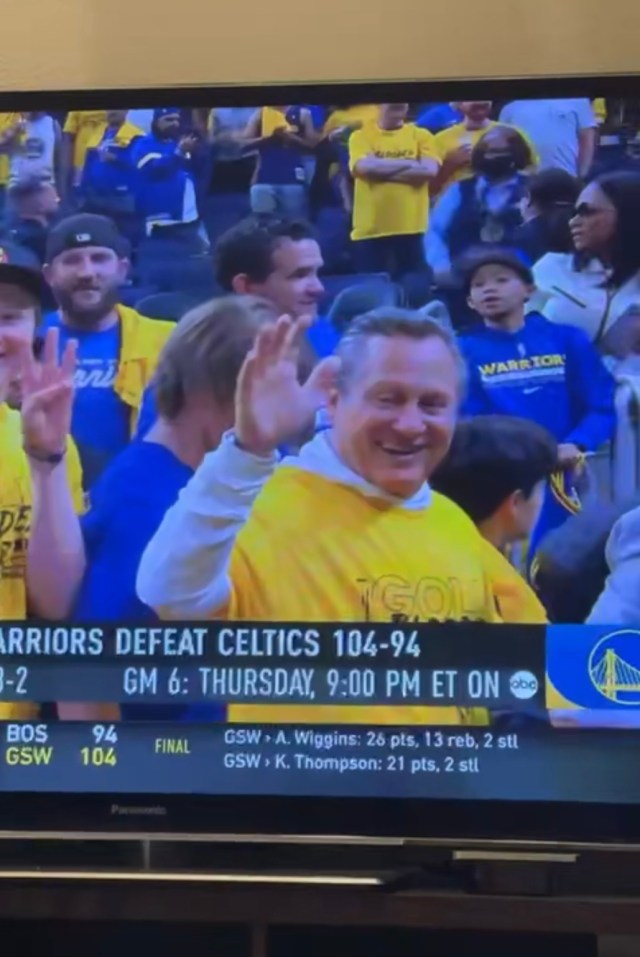
Thoughts on Leadership: Lessons from Steph Curry

By Gino Blefari

This week my travels find me starting Monday at my home office, conducting my regular WIG calls with CEOs, then flying to Orange County for meetings and events. On Tuesday, I had the early morning Berkshire Hathaway Energy call, then a breakfast meeting with Greg Abel, vice chair of non-insurance operations at Berkshire Hathaway Inc. and chairman of Berkshire Hathaway Energy. On Wednesday morning, I presented a training class at Intero’s headquarters, then joined HomeServices of America’s Chief Diversity, Equity and Inclusion Officer Teresa Palacios Smith on the debut broadcast of the new “Diversity Matters” podcast. The rest of the week was about preparing for the HomeServices of America leadership meeting and Stronger Together, both taking place next week in Palm Desert, California. Of course, between meetings, I sat down to write this post to you.

When I was on the “Diversity Matters” podcast yesterday, Teresa asked me about this blog and, for the first time ever, I announced the topic of the next “Thoughts on Leadership” before it was published. So, for those who tuned in, you’d know today I’m going to talk about Steph Curry, not only because his new documentary, “Stephen Curry: Underrated” was recently released on Apple TV+, but also because on July 16, he won the American Century Championship (ACC) celebrity golf tournament in spectacular fashion. The day before, Curry made a hole-in-one on the seventh hole, and on the last day of the tournament, he made a clutch 20-foot eagle putt on the 18th hole to win the title. As I told Teresa, there are so many lessons we can learn from the basketball superstar.

His documentary is inspiring: a tale of against-the-odds achievement on a grand scale. It begins with basketball legend Reggie Miller reading Curry’s pre-draft scouting report. The critics did not mince their words:

“Far below NBA standard in regard to explosiveness and athleticism …”

“Can overshoot and rush his shots …”

“Doesn’t like when defenses are too physical with him …”

And the best one by far:

“Do not rely on him to run your team …”

Juxtapose those comments with Curry’s four championship rings and you will laugh at how history proved these sentiments wrong. And that, perhaps, is one of the most magical things about Steph Curry and his leadership story. He constantly fought (and won) against those who second-guessed his abilities. The result? In addition to being a four-time NBA champion, Curry is also a two-time NBA Most Valuable Player, NBA Finals MVP, NBA All-Star Game MVP and a nine-time NBA All-Star. He also holds the record for all-time leader in total-3 pointers.

Underrated no more. But in the beginning, even Curry’s mom, Sonya, worried about whether her son could become an NBA player. (Notably, his father, Dell Curry, was an NBA player who retired as the all-time leading scorer of the Charlotte Hornets.) Virginia Tech, where Curry’s parents went to school, turned him down. Duke, where Curry attended a basketball camp, didn’t accept him on the team. Curry signed with Davidson College, where he played an integral role in taking the Davidson Wildcats’ basketball team to the 2008 Elite Eight in the NCAA championship. It was called “a Cinderella story for the ages,” with Curry leading the charge, and it set him on a path to greatness.

In addition to being a basketball superstar, Curry is also an avid – and scratch – golfer, who began playing at the age of 10. His commitment to the sport showed last Sunday at the Edgewood Tahoe South golf course in Stateline, Nevada for the ACC tournament. During the practice rounds, Curry walked the course with coaches, asking questions about the greens. Before the tournament, Curry spent time with legendary golf coach Butch Harmon, who has helped PGA greats Tiger Woods, Dustin Johnson and Rickie Fowler. Curry admitted to Golf Week after the coaching that what Harmon taught him would help him “build a little confidence.”

Maybe it was added confidence that propelled Curry’s tournament win, but it may have also been his desire to provide himself yet again, focusing intently on the shot in front of him. “The next shot mentality is huge,” Curry said during the tournament, according to NBA.com. “Basketball’s a little more reactive so you don’t have too much time to dwell on what’s going on. In golf, you have a long walk from shot to shot to deal with the thoughts going on between the ears. You have to have a bit of amnesia out there.”

A focus on the future informs more than Curry’s golf game. He’s also a champion for diversity, equity and inclusion, and that advocacy has intertwined with his love for golf. Curry committed to funding the Howard University golf program for six years, and he started the Underrated Golf Tour, established “to provide a positive, competitive, safe space environment for culturally diverse” junior golfers. For his tremendous efforts, the PGA honored Curry earlier this month with the 2023 Ambassador of Golf Award.

So, what’s the message? Curry’s success story proves that no matter what others say, passion will always fuel progress on and off the court.

Thoughts on Leadership: Lessons from NCAA Women’s Basketball

By Gino Blefari

This week my travels find me starting Monday with my typical WIG calls. On Tuesday, I participated in an early morning Berkshire Hathaway Energy call followed by meetings in Los Altos. On Wednesday, I had several meetings and conference calls and then this morning, I participated in the Berkshire Hathaway Energy “Our Familia” Employee Resource Group (ERG) panel with facilitator Angelica Silveyra, current Chair of the panel and director of Customer Contact at NV Energy, Amy Key, Principal Engineer with Mid-American Energy and Antoine Tilman, Vice President of Customer Operations with NV Energy. Now, I sit down to write this post to you.

It’s been a while since we covered any sports news on the blog, and if you know me, you know I love sports and the lessons they can teach us about life and leadership. So, this week, I thought we’d dive into some lessons from the NCAA women’s basketball tournament. On Sunday, Louisiana State University defeated the University of Iowa 102-85 to win the 2023 NCAA women’s college basketball national championship, claiming its first-ever national title – not only in women’s basketball but also in collegiate basketball for the university.

Read more: Thoughts on Leadership: Lessons from NCAA Women’s Basketball

In other history-making updates, the LSU Tigers and Iowa Hawkeyes combined for the most points scored in title game history, and LSU set a record for the number of points scored by a team in the final.  Here are a few key leadership takeaways from the NCAA women’s basketball tournament this year:

Play by your own rules.

After winning the tournament, LSU’s Angel Reese said: “Just keep being you. Never let anybody tell you no or that you can’t do this, you can’t do that.” She talked about how people tried to create an image of her that was unlike the way she really was – or saw herself. But as Reese explained, nobody can define who you are but you.

Yahoo! Sports writer Shalise Manza Young wrote in a poignant article published earlier this week: “Reese [is] smart enough to see the game for exactly what it is and insistent that she’ll play by her rules, thank you very much.”

I was sent Young’s article by Johnnie Johnson, my good friend and former All-Pro for the Los Angeles Rams, author of “From Athletics to Engineering: 8 Ways to Support Diversity, Equity and Inclusion for All.” In his note to me, Johnnie said when he wrote his book, he knew that talking about race would cause discomfort for a great many people. He also knew that sports at all levels of the game would continue to provide an outlet for these necessary conversations.

Reese’s “just being you” mentality is an excellent example of the kind of straightforward, honest discourse we as leaders must embrace for our team members and organizations. Diversity is as much about togetherness as it is about individuality, and Reese’s insistence that she is defined by no one but herself celebrates the progress-making combination of the two.

This tournament was more than just a collection of fantastically played games; it was a movement toward greater equality.

Caitlin Clark, a star player for the University of Iowa, helped take her team to their first championship appearance. She was named Naismith Player of the Year and was also the first player ever – in women’s and men’s NCAA basketball – to earn a 40-point triple double in tournament history. For my non-sports readers, a triple double is when a player scores at least ten points, ten rebounds, and ten assists in a single game (i.e., double digits in three categories).

The history-making, record-breaking games translated into bigger audiences than ever before. A reported 2.5 million people watched Iowa defeat Louisville in the Elite Eight, and to put that number into perspective, televised NBA games this season have averaged about 1.6 million viewers, according to Nielson data.

Yet as fantastic an athlete as Clark is, she still faced microaggressions and inappropriate comments on her highlight reels and videos. The uncalled-for comments raise serious questions about the connection between the rise in popularity of women’s sports and why they were less popular in the first place. These women are extraordinary athletes, with passion, commitment, and talent that’s incredible to watch. Everyone should tune in with just as much enthusiasm as they do for the men’s tournament – if not more. I was on the edge of my seat watching Iowa play South Carolina, texting with Iowa Realty General Manager John Dunn. At exactly 8:49 p.m. Pacific time on Friday, I texted him and asked if he was watching, to which he responded: “Epic. I can’t wait for your Thoughts on Leadership.” So, if you like this post, you have John Dunn to thank.

Sports should bring people together, not tear them apart.

This year’s NCAA women’s basketball tournament experienced a 42% jump in viewership compared with last year. And the championship game was the most-watched college women’s basketball game in the history of the sport, peaking at 12.6 million viewers.

In a Harvard Crimson article, staff writer Marley E. Dias said: “Sports are meant to bring communities together, teach children important life skills in cooperation and discipline, and entertain. The suggestion that history-making athletes like Caitlin Clark and Angel Reese are anything less than extraordinary is more than false. It is a harm to the young girls on the court striving for excellence.”

So, what’s the message? The truth is, I wish this was one leadership post I didn’t have to write. Women athletes don’t just deserve their day in the spotlight because of this tournament, they deserve their day in the spotlight because they work hard, fight for every win, and commit to greatness in a way that will inspire generations to come.

Thoughts on Leadership: Retrieving the Win

By Gino Blefari

This week my travels find me working from Northern California thanks to the fourth Nor’easter that derailed my East Coast plans while on the way to the airport to catch a flight to New Jersey. Snowed in or not, like much of the country, I’ve caught a serious case of March Madness. The tournament is exciting, fast-paced and most importantly, filled with surprising lessons on leadership.

And no match up this year—perhaps no match up in the history of the NCAA Division I Men’s Basketball Tournament—came replete with as many lessons as did Friday’s game between the No. 16 seed UMBC Golden Retrievers and the tournament’s No. 1 overall seed, the University of Virginia Cavaliers. If you didn’t watch the game or haven’t yet heard, the Retrievers not only beat the Cavaliers, they blew them out of the Spectrum Center in Charlotte, N.C., 74-54.

Continue Reading

No more posts.