Thoughts on Leadership: Finishing October with Planning, Preparation and Promise

By Gino Blefari

This week my travels find me starting the work week on Sunday with a flight to Kansas City where I prepared to testify in a class action lawsuit. On Wednesday morning, I testified in court and on Thursday, I spent some time writing this post to you.

Our October theme has been preparation, planning, time management and routine, and in case you’d like to revisit some of the posts that fit this theme, here’s a list:

Read more: Thoughts on Leadership: Finishing October with Planning, Preparation and Promise

Now, you know I love my sports, and it’s a fun coincidence that this month of planning and prep coincides with a popular baseball term, Mr. October, (or Ms. October) one of the highest honors bestowed to the most outstanding player or team in the Major League Baseball postseason. The term was coined by Reggie Jackson. In the 1977 World Series, he hit three home runs on three pitches, earning the name “Mr. October.”

In real estate, October is also your time to shine. What you do now will help determine how your 2024 will play out, and why not make it your best year yet?

As a lifelong student on a mission to perpetually improve, I’ve been on my own journey of time management and self-improvement, especially when it comes to my on-the-road routine. I found it easy to make excuses while I traveled as to why I didn’t work out that day. No hotel gym. Too tired from time zone changes. On and on the excuses went until finally I said to myself, “Enough!” I made a commitment that every day while I was traveling, I’d do a minimum of 100 air squats and a minimum of 100 pushups, no matter what. It was an easy commitment to make because those exercises can be done from anywhere.

And in making this commitment I identified a crucial component to all positive habits and time-management strategies: environmental design. Atomic Habits author James Clear wrote: “Environment is the invisible hand that shapes human behavior. We tend to believe our habits are a product of our motivation, talent, and effort. Certainly, these things matter. But the surprising thing is, especially over a long period of time, your personal characteristics tend to get overpowered by your environment.”

In other words, the key to creating more positive habits is to design an environment conducive to your success. I eliminated the need to find a gym with my air squats and push-ups commitment. I could do that from anywhere and it was easy. Clear says whenever possible, design your habits so they fit within the flow of your current processes. This way, they won’t feel like such a stark contrast but more like a welcome addition to what you’re already doing.

Another way to add positive habits and manage your time well is to ask yourself: “What pleasure will I get by doing this thing?” And “What pain will I feel if I don’t do it?” Recognize exactly what you’re giving up and gaining through the activity and you’ll be more likely to complete it.

You can even write your answers down in a notebook, and having a notebook handy is one of my strategies for better time management. There’s a direct correlation between writing something down and getting it done, and the more detail you include, the more likely you are to finish the task. Leadership author Mark Murphy, in an article for Forbes, explained: “Vividly describing your goals in written form is strongly associated with goal success, and people who very vividly describe or picture their goals are anywhere from 1.2 to 1.4 times more likely to successfully accomplish their goals than people who don’t.”

I also like to complete short tasks first, as it gives a sense of accomplishment that motivates you for the rest of your to-do list. When scheduling your week, be sure to add in a “buffer day,” which is a time for catching up on emails, returning calls, having meetings, delegating tasks, and doing paperwork. For me, those buffer days are Friday and Sunday evening.

With October coming to a close, make sure you’ve planned out the remainder of the year, including days off like holidays, vacations, birthdays, date nights, exercise sessions, doctor appointments … everything that will give your life balance. Next, plan all the training you will do, personally and professionally. Finally, schedule all the activities from your business – planning time, prospecting, lead follow-up, office meetings, staff meetings and your appointments.

So, what’s the message? As the saying goes, if it’s important to you, you’ll find a way. If it’s not, you’ll find an excuse. Let’s all commit to avoiding excuses, planning our schedules, and committing to those goals that will make our personal and professional dreams come true. And as the 2023 World Series begins Friday, be on the lookout for the next Mr. October.

Thoughts on Leadership: Fourth Quarter Positive Habits and Time Management

By Gino Blefari

This week finds me traveling back on Saturday afternoon from AREAA and meetings in Chicago, then starting Monday conducting my typical WIG calls with CEOs. On Tuesday, I participated in the early morning Berkshire Hathaway Energy call and then the monthly HomeServices of America leadership meeting. Yesterday, I had two succession calls, and today, I sat down in the morning to write this post to you.

We’ve been talking a lot about business planning and scheduling, and how the best way to ensure a strong 2024 is to do those things now. As you’ve heard me say before, real estate operates on a 90-day cycle; so much of what you do in October and November will pay out at the beginning of next year. It’s also why I say this is the perfect time to reinforce positive habits and eliminate negative ones. The time to start changing for the new year isn’t when you make resolutions for January 1 … it’s now.

Read more: Thoughts on Leadership: Fourth Quarter Positive Habits and Time Management

My own morning routine has changed for the better lately. After walking my dog June, I go straight to doing cardio on a power plate that fits right in my office, then spend 30 minutes in an infrared dry sauna before moving to a steam sauna with eucalyptus and lavender, which clears out my sinuses.

And instilling new, positive habits goes hand-in-hand with time management. As Atomic Habits author James Clear said: “Good habits make time your ally. Bad habits make time your enemy.”

It’s true. While in Chicago last week, I had the honor of presenting my “76 Points On Time Management And Efficient Operations” to the Berkshire Hathaway HomeServices Chicago team, and here are 10 takeaways from that talk:

  1. Time management and forming habits is as much about discipline and daily practice as it is about identifying the routines that will give you an edge. Once you decide on the habits you’d like to implement, your next step is committing to the daily practice of those habits, so they become part of your subconscious and a natural element of your everyday life.
  2. Pick four positive time management strategies to focus on each month; once you’ve got those down, move onto the next four in the following month. As I told the team in Chicago, don’t try to do all 76 at one time. If you start this process now, by picking four each month, you should have about 16 new and positive time management strategies incorporated into your routine by the time the new year begins.
  3. Energy is paramount. The secret to time management is that productivity isn’t about time; it’s about energy and focus. There are 1,440 minutes in a day; invest your time wisely to make the most of every moment.
  4. The task that will have the single biggest impact on your time management is prioritization. Determine and prioritize your Most Important Task each day.
  5. Don’t be afraid to say “no” to things that don’t fit your goals or schedule. Research has found that people who say “no” in response to requests for their time tend to be happier and have more energy.
  6. One quick way to improve email management (and thus time management, because how much time do we spend on email?) is to implement a policy of descriptive subject lines. This way, you can know immediately what you’re addressing in that email. Also, when the subject of the email changes, the subject line of that email should change. I abide by the “touch it once rule” for email management: answer it, delete it, or file it.
  7. Each day, list the seven most important things you need to do, noting the time it’ll take to complete each task, and get those seven things done in the time allotted. Put the most important task first. This simple step will give you a tremendous sense of control and accomplishment. According to the Law of Single Handling, the ability to start and complete your most important task determines your productivity more than any other skill. And as for the timeline, the reason why you put timelines next to each of the seven things is Parkinson’s law, which says work expands or contracts to fit the time allotted; that’s why you always want to do everything in the time it should take. You can put buffers in your schedule, but don’t pad the time it takes to do any given task.
  8. Avoid Rocking Chair Syndrome, which is movement without going anywhere at all. Mental toughness is required for real progress, and it means doing what you’re supposed to do even on the days you don’t feel like doing it. Discipline is the ability to make and keep promises to yourself, and it’ll determine your success. Remember, the pain of discipline weighs ounces, the pain of regret weighs tons. Your destiny and professional growth are your responsibility, not anyone else’s.
  9. When it comes to time management and being effective, the most important thing you can do is to follow your schedule and never make a commitment of your time without checking your schedule first. This way you won’t miss any meetings, or anything you’re asked to do. You also won’t make a commitment of your time without checking your schedule first.
  10. Have a goal board in your office. List the goals you have set and the things you have accomplished. They keep you on track. A strong accountability partner will also keep you on track with your commitments and goals. Record your numbers daily, at the same time each day. Allow 15 minutes at the end of your day to complete this task. As the saying goes: When performance is measured, performance improves. When performance is measured and reported back, the rate of improvement accelerates.

In Og Mandino’s The Greatest Salesman in the World, he offers 10 scrolls that are designed to instruct you how to take bad habits and replace them with good habits. You may all recall the famous saying: When you keep your thoughts positive, your thoughts become your words, your words become your actions, your actions become your habits and your habits become your destiny.

If you’re looking for more inspiration to begin better habit-forming practices now, here’s a good reading list to get you started:

  • The Slight Edge by Jeff Olson
  • Atomic Habits by James Clear
  • The Greatest Salesman in the World by Og Mandino
  • The Year of Yes by Shonda Rhimes
  • The Richest Man in Babylon by George S. Clason
  • Think and Grow Rich by Napoleon Hill
  • The Score Takes Care of Itself by Bill Walsh

So, what’s the message? There’s no better time than today to take a bad habit and turn it into a good one, and I’ve been endlessly inspired by Og Mandino’s teachings, and was fortunate enough to have him as a friend and mentor. Thank you, Og Mandino, for always reminding me that my life goal should not be to win or be number 1; it’s to be the best version of myself. As another mentor of mine Bill Walsh says, if you do that “the score takes care of itself.”

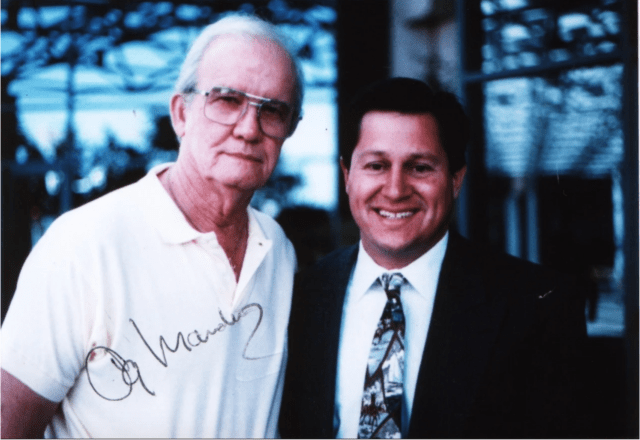
Pictured: Gino and Og Mandino circa 1986.

Thoughts on Leadership: Lessons from Mr. Irrelevant

By Gino Blefari

This week my travels find me heading to New Orleans on Monday for the Berkshire Hathaway HomeServices Marketing Forum, where the following day I delivered a presentation about the win-against-all-odds Kentucky Derby winner “Rich Strike.” On Wednesday, I traveled by car with Roberts Brothers President Teresa Williamson to Mobile, Alabama for a visit with the Roberts Brothers team. Today, I met with Roberts Brothers during their all-company sales meeting (with a Q&A led by Teresa) then hopped on a flight to Chicago for a visit with the Berkshire Hathaway HomeServices Chicago team. Tomorrow, after spending time with the Chicago team, I’ll attend an Asian Real Estate Association of America (AREAA) lunch followed by the AREAA Gala in the evening. Of course, in between meetings, I sat down to write this post to you.

Last week, I received an email from Eric Webster, general manager at Berkshire Hathaway HomeServices First Realty, in response to the weekly Thoughts on Leadership detailing lessons learned from the NFL. He wrote: “Good morning, Gino. You and I are cheering for the same guy for maybe slightly different reasons. I am a fan of [San Francisco 49ers Quarterback] Brock Purdy from his days at Iowa State.”

Read more: Thoughts on Leadership: Lessons from Mr. Irrelevant

Eric said he’d been thinking about Purdy lately as he’s been in the news for near-flawless performances during games this season, helping to lead the 49ers to a 5-0 start. (It’s certainly made my Sundays a lot more enjoyable!) In his email, Eric posed an interesting point to consider: “I’ve been wondering why he is so good today – but was only ‘good’ at Iowa State University.”

When Purdy played at Iowa State University, he was a solid player, but his team didn’t win a national championship. In the 2022 NFL Draft, he was chosen 262nd, the very last player selected, historically deemed “Mr. Irrelevant.” (He was even celebrated during “Irrelevant Week,” a charity event held each year in Newport Beach – just a few minutes’ drive away from the Berkshire Hathaway HomeServices headquarters – to celebrate the last-picked player in the NFL draft.)

Today, Purdy is the ultimate come-from-behind underdog story, very much like the story of Rich Strike I told days earlier at Marketing Forum in New Orleans. From beginning his NFL career as Mr. Irrelevant, Purdy is today starting quarterback for a so-far undefeated 49ers team. He threw four touchdown passes in Sunday’s game against the Cowboys. He has fourteen consecutive regular season wins under his belt, dating back to last season. And to echo our earlier question: Why? How did a player picked last in the NFL draft turn into such a standout?

Well, there are many reasons for Purdy’s productivity and high-performance, and each one proves a lesson in both leadership and the establishment of a mindset that embraces perpetual improvement:

  • Trust. Purdy is implicitly trusted by his teammates and 49ers Head Coach Kyle Shanahan; it’s a trust he’s earned through consistent results since taking over the starting quarterback position during Week 13 last NFL season. Shanahan says Purdy’s been “extremely consistent in practice since he’s been here, and he’s been the same in games. What you see is what we see and it’s what you feel.” Trust is earned, and trust is felt. Trust allows teams to take risks and push themselves harder on the path toward reaching their highest potential, knowing every member of the team supports the whole.
  • Progress. Some might say Purdy is the byproduct of an excellent team, a quarterback surrounded by a tough offense line that’s coached by some of the best offensive strategists in the nation. But while critics will tell you it’s only a matter of time before Purdy’s “great” turns to “not so good,” the stats are clear: Purdy keeps getting better. His time before passing improved from 2.84 seconds in 2022 to 2.56 seconds so far this season. He’s also bringing the ball farther down the field, with 7.2 air yards per attempt, up 0.2 yards from last year. Purdy’s 95.2% completion rate in Sunday’s game against the Cowboys is the best by any passer in 49ers history, and 48.2% of Purdy’s pass attempts gain a first down or touchdown, which is the highest percentage in the NFL right now. In leadership, a commitment to evolve and innovate is everything.
  • Dedication. As 49ers Left Guard Aaron Banks told ESPN: “[Purdy] is a dude who comes in and studies his film, studies his craft and makes sure he’s getting better week by week.” In leadership, a dedicated leader who is set on improvement is far more important than a leader who is complacent, even if they’re at the top of their game. Remember, once you think you know it all, your slide to mediocrity has already begun.
  • Chemistry. In Eric’s email, he said: “Something happened to Brock. He is on the right team at the right time, and they are really having fun together.” This is a true example of chemistry at play. In sports, chemistry is everything. You win or lose based on the chemistry of your leaders and your team. The same applies to business; a good leader not only understands their team’s chemistry but can also utilize it to effectively accomplish every Wildly Important Goal.

So, what’s the message? An underdog like Mr. Irrelevant has nothing to lose and everything to gain, which is the perfect recipe for success. 

Thoughts on Leadership: How’s That Business Plan Going?

By Gino Blefari

This week my travels find me starting Monday in my home office, conducting WIG calls throughout the day. On Tuesday, I participated in the early morning Berkshire Hathaway Energy call then presented a virtual leadership session for the Chalk Digital team. On Wednesday, I attended the HomeServices of America Diversity MEETS monthly meeting, and today, I sat down to write this post to you as I battle a strong cold that’s been lingering all week.

Last week, we rang in the real estate new year (read more about that here), and this week, I want to dive deeper into ways you can prepare and plan for a strong 2024. Ideally, you should complete your business plan in October; but if you haven’t started yet, you can download the Business Planning Essentials here.

Read more: Thoughts on Leadership: How’s That Business Plan Going?

Why plan in October? As I mentioned in last week’s post, real estate works on a 90-day cycle. What you do today will pay off three months from now, and concurrently, what you don’t do today will cause suffering and headache three months down the road.

Planning a full 90 days before the start of the New Year means that as soon as January 1 rolls around, you’ll already be running when you hit the ground. A business plan allows you to prepare for expected and unexpected challenges. It ensures the busy holiday season won’t stop your momentum in 2024. As the famous Ben Franklin quote goes: “A failure to plan is a plan to fail.” (Heard that one before, JT?)

A big part of business planning is planning your schedule. Once you plan your schedule, staying on your schedule is by far the most important thing you can do.

This weekend, aim to schedule out every day for the remainder of the year, including every single day off, and every day you’ll work for the rest of 2023. Make sure on those days you work, you work. On your workdays, follow your schedule, do your prospecting, and complete every task that will turn into business for you.

Then, from now to the end of the year and if you can carry it throughout the upcoming year, review your schedule for your upcoming day the night before. Every week, review your weekly schedule the Sunday before. And every month, review your monthly schedule the day before a new month begins. Having a schedule, and more importantly following your schedule, will have the biggest impact on your success.

Plus, part of business planning and scheduling naturally involves articulating your goals, and writing down goals has been proven to positively correlate to a person’s likelihood of achieving them.

In 1953, Harvard conducted a now-famous study on goal setting. Researchers asked Harvard MBA students about their goals. Here were their responses: 3% said they had clear, written goals; 13% said they had goals, but they were not written down; and 84% said they did not have goals at all. Ten years later, the study examined the success of its participants and found that the 13% who had non-written goals earned on average two times as much as the 84% of people who did not have goals. Most impressively, the study revealed that the 3% who had written goals outperformed everyone in the study by earning ten times as much as the other 97% of participants combined.

So, what’s the message? Scheduling helps you meet your goals, and goals are key to success.  Plan and schedule yourself out now, so when everyone else is working or scrambling to business-plan over the holidays, you’ll be ahead of the game and on your way to success.

No more posts.