Thoughts on Leadership: In Gratitude for YOU

By Gino Blefari

This week my travels find me at home, starting Monday with my typical WIG calls. On Tuesday, I joined the early morning Berkshire Hathaway Energy call then had four succession calls. Today, I had a few meetings and calls but mostly prepared for the four-day weekend ahead. And guess what? Exactly one year ago and a day from today, I was at the San Jose International Airport at 1:17 p.m. for my puppy pick-up and welcomed our sweet pup June to the family. A year later, I am so thankful that June joined the Blefari crew and brings so much joy to all of us. She’s a handful but we love her, and we’re grateful to have her in our lives.

Gratitude, just as it’s been all month, is really in the spotlight this week. I’m grateful for my family, friends and colleagues who have become like family, and I hope we can all take a few moments away from our holiday festivities to appreciate those who make our days that much brighter.

Continue Reading

Thoughts on Leadership: Compassion & Gratitude

By Gino Blefari

This week my travels find me starting Monday at my home office, conducting my usual WIG calls, and participating in the early morning Berkshire Hathaway Energy call. On Tuesday, I traveled to Orange County to attend the National Association of REALTORS® Annual Conference & Expo and that night, the RISMedia Power Broker Reception Dinner. On Wednesday, I had business meetings in Beverly Hills, California then traveled home in the evening. Today, I spent the morning presenting and participating in the virtual Intero Joint Leadership Meeting then sat down to write this post to you.

If you’re following along with Thoughts on Leadership this month, you’ll know that November is ‘Gratitude Month,’ when all posts explore various life-changing, business-building, leadership-enriching aspects of gratitude. In response to last week’s post about positive self-talk, I received an email from Micheline Vargas, REALTOR®/sales associate with Berkshire Hathaway HomeServices California Properties. In addition to being a real estate professional, Micheline is also a Doctor of Public Health – Preventative Care. As Micheline explained in her email, she recently gave a talk at the California Properties’ Pasadena office about the benefits of gratitude and compassion, where she used research findings to outline how gratitude and compassion “can improve emotional, physical and social well-being.” Her course description explained that “people [who] practice gratitude and compassion experience greater social connection and are more altruistic. They have increased hope, optimism, and happiness. Research shows happy people have greater productivity, improved work quality, and even make more money. Practicing gratitude and compassion is also associated with reduced stress, depression, chronic pain, and cardiovascular disease.”

Read more: Thoughts on Leadership: Compassion & Gratitude

Talk about serendipitous timing!

Because we’re focused on gratitude this month, I thought we too could take a stroll through the available research and resources on this topic as it relates to compassion and happiness, with due credit – and utmost gratitude – to Micheline for inspiring today’s post.

Before we dive into the research, let’s first draw a line between gratitude and happiness. In a 2021 article published by the Harvard Medical School, experts explained that psychological research consistently and strongly links gratitude with greater happiness: “Gratitude helps people feel more positive emotions, relish good experiences, improve their health, deal with adversity, and build strong relationships.”

Now that we see how gratitude is tied to increased happiness, let’s discuss what happens when you feel really happy.

William Shakespeare once wrote: “A merry heart goes all day. Your sad tires in a mile-a.”

In a 2005 study, “The Benefits of Frequent Positive Affect: Does Happiness Lead to Success?” published by the American Psychological Association, researchers found that those who experience positive emotions – or to use Shakespeare’s words, those who are merry – tend to not only be more successful than those who experience negative emotions but also are more accomplished across “multiple life domains.” Why? The study cited that a positive mood helps people to “think, feel and act in ways that promote both resource building and involvement with approach goals.”

In other words, positive, compassionate, and happy people believe they have the tools, skills, relationships, and knowledge necessary to achieve anything. They also believe, according to the study, that all these things can be expanded to further new goals and combat future challenges.

As for gratitude, a 2022 article published by Mayo Clinic Health System reported that the expression of gratitude doesn’t just have positive mental benefits; it has positive physical benefits, too. “Studies have shown that feeling thankful can improve sleep, mood, and immunity. Gratitude can decrease depression, anxiety, difficulties with chronic pain and risk of disease,” the authors explained, likening gratitude to a kind of happy pill that allows your brain to appreciate the good in your life rather than harp on the negative. (In Micheline’s presentation, she notes that keeping a gratitude journal has been shown to improve sleep duration by an impressive 10%.)

If you’re reading all this research and thinking, ‘Makes perfect sense, Gino, but how can I express more gratitude in my life to reap these kinds of psychological and physical rewards?’

Here are a few places to get you started:

  • Keep a gratitude journal and add the practice of writing in it to your everyday routine (you can even use my own Gratitude Journal by clicking here).
  • Write handwritten thank you notes to people in your life and mail them out or deliver them each week.
  • Thank someone mentally whenever you’re reminded of the joy and happiness they’ve brought to your life.
  • Meditate or start a practice of meditation, which puts your brain in the present moment and allows it to observe what’s happening without judgment.
  • Volunteer your time for a worthy cause dedicated to helping the lives of others (expect to experience the classic “helper’s high” feeling of elation when you do this).
  • Put your phone away on your next walk or outing, and observe the sights, sounds and smells all around you.

So, what’s the message? Joy may be the simplest form of gratitude but joy that’s shared becomes compassion, and a joyful, compassionate, grateful person is the most wonderful leader of all.

Thoughts on Leadership: In Gratitude for Positive Self-Talk

By Gino Blefari

“You are everything that is, your thoughts, your life, your dreams come true. You are everything you choose to be. You are as unlimited as the endless universe.” – Dr. Shad Helmstetter

This week my travels find me starting Monday from my home office, conducting my typical WIG calls. On Tuesday, I participated in the early morning Berkshire Hathaway Energy call then traveled to New Orleans for Wednesday’s creative presentation by Corporate Magic for the Berkshire Hathaway HomeServices Sales Convention 2024. Wednesday afternoon, I traveled home and this morning, I sat down to write this post to you.

Read more: Thoughts on Leadership: In Gratitude for Positive Self-Talk

If you read last week’s post, you’ll know we’ve officially declared November “Gratitude Month” here in Thoughts on Leadership land, a time to talk all about the ways gratitude can positively transform your business and life.

One important element of gratitude is remembering that the way you talk to yourself can have a huge impact on your mindset.

In fact, you can test the efficacy of your self-talk with a single question. Ask yourself this: “Is the way I use language programming me for success or failure?”

Your answer is your barometer for how positive or negative your self-talk is right now.

When it comes to self-talk, one of the preeminent authorities on the topic is Dr. Shad Helmstetter, founder of The Self-Talk Institute, the Self-Talk Plus App and author of more than 25 books about self-talk. (For a fantastic read, I suggest checking out Dr. Helmstetter’s best-seller, What to Say When You Talk to Yourself.) Prior to his work in the field of human behavior, Dr. Helmstetter was a foreign language interpreter for the U.S. government. It was during this time that he realized everyone thinks and speaks with their own “internal language of success or failure.” He says, “I developed a hypothesis that with the right self-talk, we could actually train our brain to think in the positive, just like learning a new language.”

After extensive research, Dr. Helmstetter’s studies found that the hypothesis was correct. One important way to retrain your self-talk is through gratitude. “Gratitude is the conscious recognition of someone else, or of the world itself, sharing its blessings with us,” Dr. Helmstetter described in an interview for Authority Magazine. “Gratitude is one of the few human emotions that can be experienced in the positive.”

Dr. Helmstetter says that one reason we don’t feel gratitude is because our negative self-talk “literally rewires gratitude out of our brains.”

In scientific terms, those who think in the negative wire their brain’s right prefrontal cortex to be stronger, he explained. Why is that so bad? Dr. Helmstetter says that the right prefrontal cortex is the area of the brain that causes us to feel afraid, to hide or to flee, and he says that people who think negatively all the time grow more neural networks and connections in the part of the brain that turns off gratitude. Conversely, those who feel gratitude and think positively build up the neural connections in the left prefrontal cortex, which is the area that helps find solutions and brings about a sense of peacefulness. If gratitude had a home in our minds, it would be in this left prefrontal cortex, according to Dr. Helmstetter, and when you think positive thoughts, this part of the brain is subsequently strengthened.

You might be reading all this and thinking, ‘OK, I want to strengthen my left prefrontal cortex, feel more gratitude and think more positively but how do I change the language of the self-talk in my brain?’

Well, you could stop yourself from what many call “doomscrolling,” or the act of picking up your phone and taking in a torrent of negative news and content. Psychologist Dr. Susan Albers says the reason many people with negative mindsets doomscroll is because for them, it’s comforting to seek out information that confirms any negative feelings they might be experiencing.

So, you could stop opening your phone and doomscrolling the internet at night. You could also repeat a list of positive affirmations in the morning. Remember, great leaders believe anything is possible because they have repeated that idea over and over again in their heads. It’s a simple idea but one that is often overlooked.

There is real strength to be found in repetition. Legendary sales trainer and my first real estate mentor Tom Hopkins once said, “Repeat anything often enough and it will start to become you.”

When I teach my course on mindset routine, I talk about the nonconscious mind being servile, which means it sets no goals of its own. It doesn’t judge the merit or the value of the request; it just tries to carry out the given order.

Denis Waitley, author of “The Psychology of Winning,” said: “When you talk to yourself, you should be your best coach and not your worst critic.” Waitley studied the effect of psycholinguistics on Olympic athletes and their coaches, and how autogenic training allowed their bodies to respond to what they said in their minds. Self-talk like: “My heart rate is slow and regular … my breathing is relaxed and effortless …”

When these athletes said these things in their minds, their bodies responded. Through repetition and the way you speak to yourself, Waitley explained, the body reacts to what you’re saying and does just that.

So, what’s the message? Brian Tracy (quoting the legendary Earl Nightingale from The Greatest Secret) says the greatest discovery in human history is that you become what you think about most of the time, which is one of the reasons why the more you study leaders, the more likely you are to become an effective leader. Self-talk, at its very essence, is what we say to ourselves all day long and how we say it. I’ll end with this anecdote from Johnny Bench, fourteen-time MLB All-Star and a two-time National League Most Valuable Player: “In the second grade, they asked us what we wanted to be. I said I wanted to be a ball player and they laughed. In the eighth grade, they asked the same question, and I said a ball player and they laughed a little more. By the eleventh grade, no one was laughing.”

Thoughts on Leadership: Gratitude Is An Attitude

By Gino Blefari

This week my travels find me working from my home office on Monday, conducting my usual WIG calls and meetings. On Tuesday, I participated in the early morning Berkshire Hathaway Energy call, and then traveled to Maui for a friend’s wedding.

The happy times we’re celebrating at my friend’s wedding remind me that gratitude is important through the good and the bad. Often, it’s even more important to find gratitude when challenges occur, causing you to adjust your strategy and find new ways to succeed. It reminds me a little of what happened when COVID first hit; there were things we did as an organization during that time – communicate more, develop more strategies for transformational change – that we should’ve been doing all along. Implementing those initiatives during the difficulties presented by the pandemic was a reminder that it’s the hard that makes you great. It’s the hard that separates you from the competition. You can have gratitude when something goes right, but you can also have gratitude when something doesn’t go exactly as it should, which in the race of life, makes you run even faster and find your stride in ways you wouldn’t have done before.

Read more: Thoughts on Leadership: Gratitude Is An Attitude

I’ve always said, “gratitude is an attitude,” and in November – National Gratitude Month – that sentiment takes center stage. To celebrate, I’ve decided all Thoughts on Leadership blog posts for the month will be about an aspect of gratitude, and how you can use it to enrich your business and life. (Also, if you have a gratitude story, please share it so we can inspire each other!)

Here are some ways gratitude can have tremendous benefits:

Mindset. Embracing gratitude helps you embrace a positive mindset, deal with adversity, build strong relationships and perpetually improve. Gratitude naturally allows you to look toward the positive and see the potential rather than the obstacles holding you back. 

No downsides. There are no downsides to bringing more gratitude into your daily routine. Oprah Winfrey once said: “Be thankful for what you have; you’ll end up having more. If you concentrate on what you don’t have, you will never have enough.” Tommy Camp, president and CEO of Berkshire Hathaway HomeServices Carolinas Realty, is always quoting Caltech Professor Dr. Roger Sperry, who said: “What you focus on expands.”

Health. Gratitude is a powerful way to improve your mental health and well-being. Zig Ziglar once said: “Gratitude is the healthiest of all human emotions. The more you express gratitude for what you have, the more likely you will have even more to express gratitude for.”

Perseverance. When you express gratitude, you’re more likely to persevere through any kind of adversity. Have you ever thought about why people quit? Or why people break the promises or commitments they make to themselves or others? Often times, it’s directly related to the excuses and justifications they make for avoiding that task or action. They’re OK with living life at half-potential because they can easily excuse away what they didn’t have the mental toughness to achieve. (By the way, on the topic of excuses, an update on my commitment to you from the last blog post: I haven’t missed a day of my 100 push-ups and air squats routine.) With gratitude, excuses become unnecessary. Gratitude allows you the opportunity to reflect on your “why” and then, when you find gratitude in your life, you do the things you need to do to become the person – and leader – you want to be.

Accountability. Do you have a gratitude partner? I know many of us have accountability partners but gratitude partners are people you text every day to let them know the three things you’re grateful for. It could be a person, an achievement, or even a good breakfast! Whatever it is, having a gratitude partner you contact regularly can keep you accountable and allow you to add more gratitude to your everyday routine.

Productivity. In a 2022 study, Harvard Business Review found that the more power leaders have within a given organization, the less likely they are to feel and express gratitude toward others. Conversely, “high-gratitude leaders” generated higher levels of performance and productivity among their teams. Theresearch revealed that“team members [prompted] to reflect on why they were grateful for their team members subsequently engaged in more deliberate and thorough integration of others’ ideas which, in turn, led to enhanced team creativity.”

So, what’s the message? Gratitude is not something to achieve, it is something to generate during the good times and the hard times. The most exciting thing about gratitude is that we all have the potential to achieve it, no matter what circumstances come our way. Everything we need to show gratitude is already within us. That incredible feeling of being grateful for the life you’re living doesn’t come from more wealth, more talent, more connections – it always and forever comes from you. And let me tell you, I’m grateful for you reading this blog week after week as we continue to become the best versions of ourselves.

Thoughts on Leadership: Finishing October with Planning, Preparation and Promise

By Gino Blefari

This week my travels find me starting the work week on Sunday with a flight to Kansas City where I prepared to testify in a class action lawsuit. On Wednesday morning, I testified in court and on Thursday, I spent some time writing this post to you.

Our October theme has been preparation, planning, time management and routine, and in case you’d like to revisit some of the posts that fit this theme, here’s a list:

Read more: Thoughts on Leadership: Finishing October with Planning, Preparation and Promise

Now, you know I love my sports, and it’s a fun coincidence that this month of planning and prep coincides with a popular baseball term, Mr. October, (or Ms. October) one of the highest honors bestowed to the most outstanding player or team in the Major League Baseball postseason. The term was coined by Reggie Jackson. In the 1977 World Series, he hit three home runs on three pitches, earning the name “Mr. October.”

In real estate, October is also your time to shine. What you do now will help determine how your 2024 will play out, and why not make it your best year yet?

As a lifelong student on a mission to perpetually improve, I’ve been on my own journey of time management and self-improvement, especially when it comes to my on-the-road routine. I found it easy to make excuses while I traveled as to why I didn’t work out that day. No hotel gym. Too tired from time zone changes. On and on the excuses went until finally I said to myself, “Enough!” I made a commitment that every day while I was traveling, I’d do a minimum of 100 air squats and a minimum of 100 pushups, no matter what. It was an easy commitment to make because those exercises can be done from anywhere.

And in making this commitment I identified a crucial component to all positive habits and time-management strategies: environmental design. Atomic Habits author James Clear wrote: “Environment is the invisible hand that shapes human behavior. We tend to believe our habits are a product of our motivation, talent, and effort. Certainly, these things matter. But the surprising thing is, especially over a long period of time, your personal characteristics tend to get overpowered by your environment.”

In other words, the key to creating more positive habits is to design an environment conducive to your success. I eliminated the need to find a gym with my air squats and push-ups commitment. I could do that from anywhere and it was easy. Clear says whenever possible, design your habits so they fit within the flow of your current processes. This way, they won’t feel like such a stark contrast but more like a welcome addition to what you’re already doing.

Another way to add positive habits and manage your time well is to ask yourself: “What pleasure will I get by doing this thing?” And “What pain will I feel if I don’t do it?” Recognize exactly what you’re giving up and gaining through the activity and you’ll be more likely to complete it.

You can even write your answers down in a notebook, and having a notebook handy is one of my strategies for better time management. There’s a direct correlation between writing something down and getting it done, and the more detail you include, the more likely you are to finish the task. Leadership author Mark Murphy, in an article for Forbes, explained: “Vividly describing your goals in written form is strongly associated with goal success, and people who very vividly describe or picture their goals are anywhere from 1.2 to 1.4 times more likely to successfully accomplish their goals than people who don’t.”

I also like to complete short tasks first, as it gives a sense of accomplishment that motivates you for the rest of your to-do list. When scheduling your week, be sure to add in a “buffer day,” which is a time for catching up on emails, returning calls, having meetings, delegating tasks, and doing paperwork. For me, those buffer days are Friday and Sunday evening.

With October coming to a close, make sure you’ve planned out the remainder of the year, including days off like holidays, vacations, birthdays, date nights, exercise sessions, doctor appointments … everything that will give your life balance. Next, plan all the training you will do, personally and professionally. Finally, schedule all the activities from your business – planning time, prospecting, lead follow-up, office meetings, staff meetings and your appointments.

So, what’s the message? As the saying goes, if it’s important to you, you’ll find a way. If it’s not, you’ll find an excuse. Let’s all commit to avoiding excuses, planning our schedules, and committing to those goals that will make our personal and professional dreams come true. And as the 2023 World Series begins Friday, be on the lookout for the next Mr. October.

Thoughts on Leadership: Fourth Quarter Positive Habits and Time Management

By Gino Blefari

This week finds me traveling back on Saturday afternoon from AREAA and meetings in Chicago, then starting Monday conducting my typical WIG calls with CEOs. On Tuesday, I participated in the early morning Berkshire Hathaway Energy call and then the monthly HomeServices of America leadership meeting. Yesterday, I had two succession calls, and today, I sat down in the morning to write this post to you.

We’ve been talking a lot about business planning and scheduling, and how the best way to ensure a strong 2024 is to do those things now. As you’ve heard me say before, real estate operates on a 90-day cycle; so much of what you do in October and November will pay out at the beginning of next year. It’s also why I say this is the perfect time to reinforce positive habits and eliminate negative ones. The time to start changing for the new year isn’t when you make resolutions for January 1 … it’s now.

Read more: Thoughts on Leadership: Fourth Quarter Positive Habits and Time Management

My own morning routine has changed for the better lately. After walking my dog June, I go straight to doing cardio on a power plate that fits right in my office, then spend 30 minutes in an infrared dry sauna before moving to a steam sauna with eucalyptus and lavender, which clears out my sinuses.

And instilling new, positive habits goes hand-in-hand with time management. As Atomic Habits author James Clear said: “Good habits make time your ally. Bad habits make time your enemy.”

It’s true. While in Chicago last week, I had the honor of presenting my “76 Points On Time Management And Efficient Operations” to the Berkshire Hathaway HomeServices Chicago team, and here are 10 takeaways from that talk:

  1. Time management and forming habits is as much about discipline and daily practice as it is about identifying the routines that will give you an edge. Once you decide on the habits you’d like to implement, your next step is committing to the daily practice of those habits, so they become part of your subconscious and a natural element of your everyday life.
  2. Pick four positive time management strategies to focus on each month; once you’ve got those down, move onto the next four in the following month. As I told the team in Chicago, don’t try to do all 76 at one time. If you start this process now, by picking four each month, you should have about 16 new and positive time management strategies incorporated into your routine by the time the new year begins.
  3. Energy is paramount. The secret to time management is that productivity isn’t about time; it’s about energy and focus. There are 1,440 minutes in a day; invest your time wisely to make the most of every moment.
  4. The task that will have the single biggest impact on your time management is prioritization. Determine and prioritize your Most Important Task each day.
  5. Don’t be afraid to say “no” to things that don’t fit your goals or schedule. Research has found that people who say “no” in response to requests for their time tend to be happier and have more energy.
  6. One quick way to improve email management (and thus time management, because how much time do we spend on email?) is to implement a policy of descriptive subject lines. This way, you can know immediately what you’re addressing in that email. Also, when the subject of the email changes, the subject line of that email should change. I abide by the “touch it once rule” for email management: answer it, delete it, or file it.
  7. Each day, list the seven most important things you need to do, noting the time it’ll take to complete each task, and get those seven things done in the time allotted. Put the most important task first. This simple step will give you a tremendous sense of control and accomplishment. According to the Law of Single Handling, the ability to start and complete your most important task determines your productivity more than any other skill. And as for the timeline, the reason why you put timelines next to each of the seven things is Parkinson’s law, which says work expands or contracts to fit the time allotted; that’s why you always want to do everything in the time it should take. You can put buffers in your schedule, but don’t pad the time it takes to do any given task.
  8. Avoid Rocking Chair Syndrome, which is movement without going anywhere at all. Mental toughness is required for real progress, and it means doing what you’re supposed to do even on the days you don’t feel like doing it. Discipline is the ability to make and keep promises to yourself, and it’ll determine your success. Remember, the pain of discipline weighs ounces, the pain of regret weighs tons. Your destiny and professional growth are your responsibility, not anyone else’s.
  9. When it comes to time management and being effective, the most important thing you can do is to follow your schedule and never make a commitment of your time without checking your schedule first. This way you won’t miss any meetings, or anything you’re asked to do. You also won’t make a commitment of your time without checking your schedule first.
  10. Have a goal board in your office. List the goals you have set and the things you have accomplished. They keep you on track. A strong accountability partner will also keep you on track with your commitments and goals. Record your numbers daily, at the same time each day. Allow 15 minutes at the end of your day to complete this task. As the saying goes: When performance is measured, performance improves. When performance is measured and reported back, the rate of improvement accelerates.

In Og Mandino’s The Greatest Salesman in the World, he offers 10 scrolls that are designed to instruct you how to take bad habits and replace them with good habits. You may all recall the famous saying: When you keep your thoughts positive, your thoughts become your words, your words become your actions, your actions become your habits and your habits become your destiny.

If you’re looking for more inspiration to begin better habit-forming practices now, here’s a good reading list to get you started:

  • The Slight Edge by Jeff Olson
  • Atomic Habits by James Clear
  • The Greatest Salesman in the World by Og Mandino
  • The Year of Yes by Shonda Rhimes
  • The Richest Man in Babylon by George S. Clason
  • Think and Grow Rich by Napoleon Hill
  • The Score Takes Care of Itself by Bill Walsh

So, what’s the message? There’s no better time than today to take a bad habit and turn it into a good one, and I’ve been endlessly inspired by Og Mandino’s teachings, and was fortunate enough to have him as a friend and mentor. Thank you, Og Mandino, for always reminding me that my life goal should not be to win or be number 1; it’s to be the best version of myself. As another mentor of mine Bill Walsh says, if you do that “the score takes care of itself.”

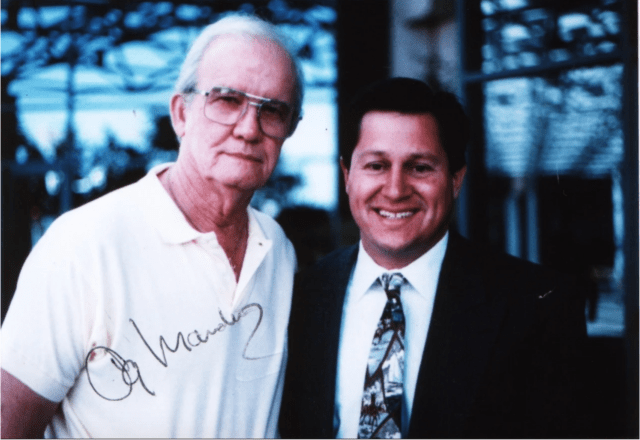
Pictured: Gino and Og Mandino circa 1986.

Thoughts on Leadership: Lessons from Mr. Irrelevant

By Gino Blefari

This week my travels find me heading to New Orleans on Monday for the Berkshire Hathaway HomeServices Marketing Forum, where the following day I delivered a presentation about the win-against-all-odds Kentucky Derby winner “Rich Strike.” On Wednesday, I traveled by car with Roberts Brothers President Teresa Williamson to Mobile, Alabama for a visit with the Roberts Brothers team. Today, I met with Roberts Brothers during their all-company sales meeting (with a Q&A led by Teresa) then hopped on a flight to Chicago for a visit with the Berkshire Hathaway HomeServices Chicago team. Tomorrow, after spending time with the Chicago team, I’ll attend an Asian Real Estate Association of America (AREAA) lunch followed by the AREAA Gala in the evening. Of course, in between meetings, I sat down to write this post to you.

Last week, I received an email from Eric Webster, general manager at Berkshire Hathaway HomeServices First Realty, in response to the weekly Thoughts on Leadership detailing lessons learned from the NFL. He wrote: “Good morning, Gino. You and I are cheering for the same guy for maybe slightly different reasons. I am a fan of [San Francisco 49ers Quarterback] Brock Purdy from his days at Iowa State.”

Read more: Thoughts on Leadership: Lessons from Mr. Irrelevant

Eric said he’d been thinking about Purdy lately as he’s been in the news for near-flawless performances during games this season, helping to lead the 49ers to a 5-0 start. (It’s certainly made my Sundays a lot more enjoyable!) In his email, Eric posed an interesting point to consider: “I’ve been wondering why he is so good today – but was only ‘good’ at Iowa State University.”

When Purdy played at Iowa State University, he was a solid player, but his team didn’t win a national championship. In the 2022 NFL Draft, he was chosen 262nd, the very last player selected, historically deemed “Mr. Irrelevant.” (He was even celebrated during “Irrelevant Week,” a charity event held each year in Newport Beach – just a few minutes’ drive away from the Berkshire Hathaway HomeServices headquarters – to celebrate the last-picked player in the NFL draft.)

Today, Purdy is the ultimate come-from-behind underdog story, very much like the story of Rich Strike I told days earlier at Marketing Forum in New Orleans. From beginning his NFL career as Mr. Irrelevant, Purdy is today starting quarterback for a so-far undefeated 49ers team. He threw four touchdown passes in Sunday’s game against the Cowboys. He has fourteen consecutive regular season wins under his belt, dating back to last season. And to echo our earlier question: Why? How did a player picked last in the NFL draft turn into such a standout?

Well, there are many reasons for Purdy’s productivity and high-performance, and each one proves a lesson in both leadership and the establishment of a mindset that embraces perpetual improvement:

  • Trust. Purdy is implicitly trusted by his teammates and 49ers Head Coach Kyle Shanahan; it’s a trust he’s earned through consistent results since taking over the starting quarterback position during Week 13 last NFL season. Shanahan says Purdy’s been “extremely consistent in practice since he’s been here, and he’s been the same in games. What you see is what we see and it’s what you feel.” Trust is earned, and trust is felt. Trust allows teams to take risks and push themselves harder on the path toward reaching their highest potential, knowing every member of the team supports the whole.
  • Progress. Some might say Purdy is the byproduct of an excellent team, a quarterback surrounded by a tough offense line that’s coached by some of the best offensive strategists in the nation. But while critics will tell you it’s only a matter of time before Purdy’s “great” turns to “not so good,” the stats are clear: Purdy keeps getting better. His time before passing improved from 2.84 seconds in 2022 to 2.56 seconds so far this season. He’s also bringing the ball farther down the field, with 7.2 air yards per attempt, up 0.2 yards from last year. Purdy’s 95.2% completion rate in Sunday’s game against the Cowboys is the best by any passer in 49ers history, and 48.2% of Purdy’s pass attempts gain a first down or touchdown, which is the highest percentage in the NFL right now. In leadership, a commitment to evolve and innovate is everything.
  • Dedication. As 49ers Left Guard Aaron Banks told ESPN: “[Purdy] is a dude who comes in and studies his film, studies his craft and makes sure he’s getting better week by week.” In leadership, a dedicated leader who is set on improvement is far more important than a leader who is complacent, even if they’re at the top of their game. Remember, once you think you know it all, your slide to mediocrity has already begun.
  • Chemistry. In Eric’s email, he said: “Something happened to Brock. He is on the right team at the right time, and they are really having fun together.” This is a true example of chemistry at play. In sports, chemistry is everything. You win or lose based on the chemistry of your leaders and your team. The same applies to business; a good leader not only understands their team’s chemistry but can also utilize it to effectively accomplish every Wildly Important Goal.

So, what’s the message? An underdog like Mr. Irrelevant has nothing to lose and everything to gain, which is the perfect recipe for success. 

Thoughts on Leadership: How’s That Business Plan Going?

By Gino Blefari

This week my travels find me starting Monday in my home office, conducting WIG calls throughout the day. On Tuesday, I participated in the early morning Berkshire Hathaway Energy call then presented a virtual leadership session for the Chalk Digital team. On Wednesday, I attended the HomeServices of America Diversity MEETS monthly meeting, and today, I sat down to write this post to you as I battle a strong cold that’s been lingering all week.

Last week, we rang in the real estate new year (read more about that here), and this week, I want to dive deeper into ways you can prepare and plan for a strong 2024. Ideally, you should complete your business plan in October; but if you haven’t started yet, you can download the Business Planning Essentials here.

Read more: Thoughts on Leadership: How’s That Business Plan Going?

Why plan in October? As I mentioned in last week’s post, real estate works on a 90-day cycle. What you do today will pay off three months from now, and concurrently, what you don’t do today will cause suffering and headache three months down the road.

Planning a full 90 days before the start of the New Year means that as soon as January 1 rolls around, you’ll already be running when you hit the ground. A business plan allows you to prepare for expected and unexpected challenges. It ensures the busy holiday season won’t stop your momentum in 2024. As the famous Ben Franklin quote goes: “A failure to plan is a plan to fail.” (Heard that one before, JT?)

A big part of business planning is planning your schedule. Once you plan your schedule, staying on your schedule is by far the most important thing you can do.

This weekend, aim to schedule out every day for the remainder of the year, including every single day off, and every day you’ll work for the rest of 2023. Make sure on those days you work, you work. On your workdays, follow your schedule, do your prospecting, and complete every task that will turn into business for you.

Then, from now to the end of the year and if you can carry it throughout the upcoming year, review your schedule for your upcoming day the night before. Every week, review your weekly schedule the Sunday before. And every month, review your monthly schedule the day before a new month begins. Having a schedule, and more importantly following your schedule, will have the biggest impact on your success.

Plus, part of business planning and scheduling naturally involves articulating your goals, and writing down goals has been proven to positively correlate to a person’s likelihood of achieving them.

In 1953, Harvard conducted a now-famous study on goal setting. Researchers asked Harvard MBA students about their goals. Here were their responses: 3% said they had clear, written goals; 13% said they had goals, but they were not written down; and 84% said they did not have goals at all. Ten years later, the study examined the success of its participants and found that the 13% who had non-written goals earned on average two times as much as the 84% of people who did not have goals. Most impressively, the study revealed that the 3% who had written goals outperformed everyone in the study by earning ten times as much as the other 97% of participants combined.

So, what’s the message? Scheduling helps you meet your goals, and goals are key to success.  Plan and schedule yourself out now, so when everyone else is working or scrambling to business-plan over the holidays, you’ll be ahead of the game and on your way to success.

Thoughts on Leadership: Happy Real Estate New Year!

By Gino Blefari

This week my travels find me starting Monday in my home office, conducting WIG calls with our CEOs. On Tuesday, I joined the early morning Berkshire Hathaway Energy call, then hopped on a flight to Houston, Texas. On Tuesday night, I co-hosted two receptions with HomeServices of America’s Chief Diversity, Equity and Inclusion Officer Teresa Palacios Smith for The Alliance LGBTQ+ Real Estate Alliance & Housing Industry Conference; then on Wednesday morning, I delivered a keynote, “Unlocking Triumph: Surpassing Limits Against All Odds” to an absolutely electric and appreciative crowd. From Houston, I traveled to Miami, Florida to attend the annual National Association of Hispanic Real Estate Professionals® (NAHREP) conference, NAHREP at L’ATTITUDE, where upon arrival, I joined the welcome reception trade show. My suitcase did not show up, so I was thinking I’d have to be in sweats, tennis shoes and sneakers for the reception but luckily, Hector Sepulveda from Long and Foster stopped by the booth. You’ve heard of giving someone the shirt off your back? Well, he gave me the jacket off his back! I felt very Miami Vice in the new, borrowed outfit. (Pictured below.) Also, at NAHREP, I co-hosted one evening reception and had a chance to connect with NAHREP members from around the world. Of course, I took some time in between meetings and sessions to write this post to you.

First things first: HAPPY NEW YEAR!

Read more: Thoughts on Leadership: Happy Real Estate New Year!

You might be thinking, “Gino, what? Happy New Year now?”

Yep! I’m commemorating the new year a few months early because the real estate new year begins Sunday, October 1. In a fantastic, new YouTube video, Joe Stacy, executive vice president, general growth manager and designated managing broker at Berkshire Hathaway HomeServices Chicago reiterated this statement, explaining: “What you do in the last three months of this year is going to have a direct impact on what you get done in your business in 2024.”

Here’s the gist: Your new year is about to start because when October 1 rolls around, it’ll signify the end of the third quarter and the start of the final 90 days of the year. Why is this so significant to us as a starting point for the new year? Because in real estate, we operate on a 90-day cycle. All the prospecting, lead generation, planning and marketing we do now is going to pay off three months from now. It’s why our new year doesn’t start when the clock strikes midnight and January 1 arrives. Our new year begins Sunday.

There’s something else to keep in mind as we ring in the Real Estate New Year: This is when your 2023 business planning must begin. (You can download the Business Planning Essentials here.)

Having a solid business plan will keep you from the dreaded Q1 slump. Each year, when Q4 – and the holidays – roll around, with all its sugar cookies and holiday-party reverie, people tend to get off schedule. But if you skip ahead 90 days from the holiday-themed celebrations, you’ll get to Q1, which is exactly where most real estate agents see the lag from a slower holiday season.

During my 30+ years in real estate – as an agent, manager, and owner of a company – I’ve found there’s typically a cash flow problem in January and February. This applies to agents as much as it applies to brokerage owners.

A business plan allows you to plan for what’s ahead and avoid that problem. It ensures the busy holiday season won’t stop your momentum in 2024. And considering October 1 as the start of the new year instills a hearty level of discipline into your business operations, so you kick off the (real) new year strong.

It reminds me a lot of football, and specifically Mike McDaniel, head coach of the Miami Dolphins, the team that defeated the Denver Broncos 70-20 on Sunday in their home opener, recording the second most points by a team in a regular season game in NFL history.

A performance like that doesn’t happen by accident. McDaniel’s leadership is the perfect example of what you can achieve when you’re focused, disciplined, and prepared earlier than anyone else. I’ve briefly mentioned this story before, however I want to go into more detail now, as it applies to preparation and planning: McDaniel’s October 1 New Year is 3 a.m. every day, the time when he arrives at the office. His 3 a.m. workday routine began in 2008, when as a 25-year-old Houston Texans assistant head coach under then head coach Gary Kubiak, McDaniel messed up. Kubiak would call his assistant head coach’s office phone at 6 a.m. on the dot each morning and two times, McDaniel didn’t pick up. Because he was late those two times, Kubiak fired McDaniel. The head coach thought McDaniel had to learn a life lesson, and as McDaniel explained in an ESPN special: “In my mind, I was late twice. What he was telling me is that you do whatever it takes to get things done.”

It would take a few years before McDaniel finally understood the message. After exactly 865 days out of the NFL, McDaniel returned to coaching and vowed he’d never, ever be late to the office again. He would instill a sense of unrelenting discipline into his life and never have to risk losing his dream job – or his dreams. Cut to Sunday night and McDaniel’s team is breaking records, and he’s still leaving his house at 2:24 a.m. to arrive at the stadium in Miami Gardens at exactly 2:51 a.m., settling into his desk just before 3 a.m. There’s another number he keeps on his desk: 2:46, which is the exact time Dolphins owner Mr. Stephen Ross called McDaniel and told him he was head coach. The two numbers displayed in McDaniel’s office, 865 and 2:46, represent opportunity lost and gained.

So, what’s the message? Like McDaniel, it’s discipline that will help us grow. It’s the reminder that if we just do things earlier than everyone else, if we celebrate our new year in October, if we plan for 2024 now, if we fully prepare for what’s ahead, then nothing is impossible, and everything is within our reach.

Thoughts on Leadership: Leadership Lessons from Coach Prime

By Gino Blefari

This week my travels find me working from home, completing my usual WIG calls with our CEOs and attending various business meetings. On Tuesday, I attended the monthly virtual leadership meeting, and on Wednesday, I had my early morning Berkshire Hathaway Energy call followed by breakfast with Ronnie Lott and The Golden Heart Fund, then stopped in to see Tom Ferry, who interviewed me onstage at the Tom Ferry Roadmap 23 tour. Today, I sat down between meetings to write this post to you as I prepare to attend the 49ers vs. Giants home game with Chris Sears and many other friends later tonight. Go Niners!

Excitement for the game – and chatting with Tom Ferry – has me thinking about leadership, football and coaching, which was already on my mind as I watched the latest “60 Minutes” episode featuring Deion Sanders, or “Coach Prime,” a former NFL player-turned- college-football coach. He won Super Bowl XXIX with the 49ers then Super Bowl XXX with the Dallas Cowboys, and played professional baseball during his epic athletic career. He’s typically known as a cornerback; however it must be noted that he sometimes came in on offense and played receiver.

Read more: Thoughts on Leadership: Leadership Lessons from Coach Prime

And if you’ve been following the sports news lately, it’s hard not to come across an attention-catching headline about Deion Sanders’ near-legendary turnaround of the Colorado Buffaloes.

The story begins in December 2022, when it was announced Sanders would leave his position as head coach of the Jackson State University Tigers to become the new head coach of the Colorado Buffaloes. Sanders had his work cut out for him. I Colorado Buffaloes are in the NCAA Division I Football Bowl Subdivision (previously known as Division I-A), the highest level of college football in the U.S., but at the time, they were infamously flailing. They’d just come off a disappointing 1-11 season, and it was now Coach Prime’s job to turn things around.

In a recent memo to his team, ReeceNichols Real Estate SVP of Brokerage Chad Dumas talked about Sanders’ leadership, writing: “There are so many things he has done and said in the last couple of years that I think we can learn from as leaders, but I want to hone in on what I believe is a masterclass on recruiting and attraction.”

At the first Buffaloes team meeting in December, Sanders didn’t mince words, encouraging players to enter the transfer portal and find other schools at which they could play. “I came to the conclusion that a multitude of [the players] couldn’t help us get to where we wanted to go,” he said during the “60 Minutes” interview.

Immediately, 41 scholarship players transferred out and when the 2023 season began, Sanders had just 20 of the 83 scholarship players from the 2022 season still on his roster. Yet he was able to replace them in a few short months with new talent. In fact, in Colorado’s opening game against the TCU Horned Frogs (a team that played in last year’s national championship), the Buffaloes defeated the Horned Frogs 45-42 in a dramatic and much-talked-about double-overtime victory.

How was he able to recruit top players so quickly?

Sanders’ mantra is “I ain’t hard to find,” and it’s a testament not only to his visibility in the media and accessibility to his team (he’s been on “60 Minutes,” ESPN, and conducted a host of other high-profile interviews) but also to his candor and honesty during those interviews. Coach Prime says it like it is – the good, the bad and all the confidence you’ll find in between. As Chad said in his memo: “There’s never been a time where [being visible] is easier to do than now, but it takes discipline and a plan and a belief in yourself that when you are easier to find and putting yourself out there more, people will be attracted to you.”

Of course, being transparent and visible requires a high level of self-belief, which naturally plays into Coach Prime’s tough-love coaching philosophy. “If you went for that, if you were able to let words run you off, you ain’t for us,” Sanders said of his now-famous speech to the Buffalo players about finding another school. “We’re an old-school staff. We coach hard. We coach tough. We’re disciplinarians. If you’re allowing verbiage to run you off because you don’t feel secure with your ability, you ain’t for us.”

And for those players who heard his words and wanted to remain on the team? “Stay,” Coach Prime said. “Prove it.”

Sanders’ tough-love mentality extends to his kids, including Shedeur Sanders, quarterback of the Buffaloes and Shilo Sanders, Colorado’s starting safety. Coach Prime said if his kids called him up and said their coach told them to get in the transfer portal, he’d tell them they must not be playing as well as they should. “You should be an asset and not a liability,” Sanders explained.

As an example of Sanders’ unwavering confidence,after “60 Minutes” asked him about the best coach in college football today, he replied: “Let me see a mirror.” He did go on to clarify how much he admires University of Alabama head coach Nick Saban, and how just sitting in his presence is a gift and a reminder to be a perpetual student of his craft. “He’s forgotten more things than I may ever accomplish, so I am a student looking up to this wonderful teacher saying, ‘Just throw me a crumb of what you know.’”

So, what’s the message? Coach Prime says being a coach means you have to understand that what your team wants from you is a leader who will be honest, fair, tough, disciplined, supportive, visible and there for them, always. “I ain’t hard to find,” he says, and every player on his now 3-0 Colorado Buffaloes team knows it’s true.

No more posts.