Thoughts on Leadership: Lessons from Neil deGrasse Tyson

By Gino Blefari

This week my travels find me starting Monday at home, participating in an early morning Berkshire Hathaway Energy call followed by leadership WIG calls. My WIGs for the week are to prepare for the T3 Sixty roundtable I’ll participate in soon and take two days at the end of the week to attend my niece’s out-of-town wedding. Of course, this morning, I sat down to write this post to you.

Last week we talked about mentors, and how you can have mentors you’ve never even met – such as from a book, podcast or documentary. I’d like to tell you about another mentor of mine. Let’s rewind a few years …

Read more: Thoughts on Leadership: Lessons from Neil deGrasse Tyson

One of the benefits of staying at home during COVID was watching TV shows I didn’t have the time to watch before. After a few weeks of this new habit, I got concerned I was spending too much time watching mind-numbing Netflix series. I’ve always had a morning routine, but I decided I needed an evening routine that would consist of doing some sort of cardio for 30 minutes, walking after dinner, going in my infrared sauna, and watching a series for at least one hour that would teach me something new.

So, with this mission in mind, I started the “Cosmos” series (highly recommend it), which is how I first became enamored with a mentor I’d never met: Neil deGrasse Tyson. When I finished the “Cosmos” series I was so interested in how the universe works that I started the aptly named series “How the Universe Works.” It was through this series that I discovered and later met Hakeem Oluseyi, who became another mentor of mine and was the keynote speaker at our HomeServices of America Stronger Together conference and the Berkshire Hathaway HomeServices Summit conference.

But let’s get back to the cosmos. A brilliant educator, Neil deGrasse Tyson has inspired so many – including myself – to think bigger (like the entire universe bigger) and analyze complex ideas with a different frame of mind. Here are a few leadership lessons from this fascinating astrophysicist:

Be careful with the word “nothing.” In leadership, a tiny task might seem like nothing, or a small win might seem insignificant but as Neil deGrasse Tyson explains, our concept of a “true nothing” is harder to find than one might think. What is nothing? Is nothing what separates the empty space between the device you’re using to read this post and yourself? No. That’s air. Let’s then move to a place where there’s no air, outside of our atmosphere. Is that nothing? No, deGrasse Tyson says there are “still a few particles floating there between the planets.” What about between the stars? There may be less there but there is still something. How about between the galaxies? Well, there’s less than between the stars but still, deGrasse Tyson says a “few particles per cubic meter lurk there.” If you could hypothetically remove those particles, is what’s left considered nothing? He says, according to quantum physics: “In the pure vacuum of space there’s something called virtual particles that pop in and out of space.” Ah, again that’s not nothing. To get a true nothing, deGrasse Tyson says you’d have to arrive at a place where there is no space and no time; however if the laws of physics apply, then “there’s still something there” he says. A true nothing would be a place where there’s no matter, no space-time, and no laws at all. So, the next time you say, “Oh that’s nothing” or dismiss a small accomplishment as “nothing,” think about the true definition of nothing, and it will bring much more meaning to the topic at hand.

You lead by providing understanding, not by exercising authority. deGrasse Tyson says he wants his lasting impact on the world to be that people no longer think of him when they think about the things he’s taught them. With his guidance, they have arrived at a whole new way of understanding how the world works because he gave them the tools to think differently. “I become irrelevant,” deGrasse Tyson says. Instead of leading with authority – do this or say that – he wants to teach. Then, he says, “They can run off and don’t even look back.”

Never lose your sense of curiosity. As a kid, “everything is new” deGrasse Tyson explains, relaying a tale about a mother he saw walking with her small 3- or 4-year-old child approaching a “big, juicy puddle” on the ground. “I said, ‘please let this kid jump in the puddle,’” deGrasse Tyson explains. But instead, the mother pulled him away. “It was an experiment in cratering,” deGrasse Tyson says. If the child had jumped in the puddle, the child would get to see the impact of a downward force operating on a fluid, but because he was prevented from experiencing the puddle jump, the child can’t see it at all. “It was a bit of curiosity in that moment that was extinguished,” deGrasse Tyson says. With his own kids, if it was something that wasn’t going to severely harm them, de Grasse Tyson let them jump in puddles and experiment with the world. “I have pretty high confidence they will retain that curiosity,” he explains, defining an adult scientist as “a kid who has never lost their curiosity.” Similarly, the best kind of leaders are ones who never lose their curiosity to explore and learn about the world around them.

There’s a difference between opinion and objective fact. Interestingly, deGrasse Tyson isn’t a big fan of debates, which he thinks are mostly won on charisma and the strength of a debater’s communications skills. “If I’m good at saying, ‘the sky is green’ and I have charisma and I win the debate, that doesn’t make the sky green,” he explains. He says debating is grandstanding an idea rather than arriving at an actual solution. Instead, he separates debating opinions from objectively analyzing a solution and arriving at a decision based on fact and truth, which is the basis of scientific discovery.

So, what’s the message? In the spirit of learning something new every day, I encourage you to google Neil deGrasse Tyson, read his books and listen to his StarTalk podcast. I’m amazed and learn so much every time I do.


Thoughts on Leadership: Leveraging Change

By Gino Blefari

This week my travels found me traveling to Dallas on Monday to participate in a HomeServices leadership meeting, then flying home Tuesday evening to attend meetings for the rest of the week. And of course, earlier this morning, I sat down to write this post to you.

Today I want to talk about change. When HomeServices was founded in 1998, it was on a mission to do things differently: to change the brokerage model and to embrace an ongoing commitment to innovation. That mission has led to years of financial success and a legacy that’s unstoppable, and that 1998 mindset is one we must still embrace today.

Read more: Thoughts on Leadership: Leveraging Change

Twenty-five years ago, the world was much different. To give you an idea, here’s what life in 1998 was like:

  • Top movie: Titanic (no reflection on today’s real estate market)
  • Top TV show: ER (no reflection on today’s interest rates)

The top Fortune 500 companies changed a lot, too. In 1998, General Motors, Ford Motors and Exxon ranked in the top 3, respectively. Today, the top 3 Fortune 500 companies include Walmart, Amazon, and Apple. Do you know how many of the top 10 companies from 1998 made the list today? Two. In fact, Google was founded on September 4, 1998! A total of 179 of the current Fortune 500 companies didn’t exist in 1998, and more than half – exactly 291 – of those Fortune 500 companies on the 1998 list are no longer in business today.

In life and in business, there will always be someone who’s better. There will always be another level to achieve your stretch goal. Please understand that your stretch goal is someone else’s baseline … but the truth is, you should have a baseline that’s a standard people can’t even aspire to achieve. You should have goals so big they scare you, goals that the person reading (or writing) these words right now doesn’t even yet have the capacity to achieve.

Every goal you accomplish in your life means that you have become a better version of yourself to achieve it. And that means setting a standard higher than anyone else’s. There will always be another level. There is no “I’ve arrived.” That’s when complacency sets in. Complacency is the most insidious disease in the world. It just sits up on your shoulder and says, “Everything’s fine, I’m doing great. No need to improve.” That’s when we stop learning. That’s when we stop growing.

To prevent complacency, here’s how adopting the mindset of embracing change has defined HomeServices over the last 25 years:

Number 1 – Know that there’s always somebody who is playing at a higher level. There’s somebody who is creating distance from you, and your job is to catch up and pass them. You must create goals that inspire you to become even more than you are right now.

Number 2 – Find mentors. A mentor will take you from where you are today to somewhere entirely new. They’ll move you in ways you can’t move yourself. And a mentor doesn’t have to be a physical person standing in front of you or someone texting you every day. It can be a book, a podcast, an article you read online or a YouTube video. Mentors don’t have to know they’re mentoring you to do it. For me, Earl Nightingale was a mentor with his recording of “The Strangest Secret.” John Wooden was a mentor of mine with his pyramid of success, which became the foundation for the Intero Value Pyramid. Jim Collins became a mentor with his book, “From Good to Great,” which was integral to the original vision of Intero. Jim Rohn became a mentor. Brian Tracy became a mentor. Zig Ziglar, Anthony (Tony) Robbins, Jack Welch, Neil deGrasse Tyson, Warren Buffett, Greg Abel … you must have mentors in your life because you must have leaders in your life who have been where you want to go.

Number 3 – Remember that inspirational discontentment is your friend. You will never make any dramatic change in your life until you become so upset with where you are that you finally do the things you’ve been avoiding doing. When you’re discontented enough, you will do them. You can complete all the busy work in the world, but as Jim Rohn would say: “Never mistake activity for achievement.” Once you become frustrated enough with your life, you’ll make the significant changes necessary to become better and finish the work you’ve been avoiding. Inspirational discontentment is not a setback, it’s a tool for transformation beyond your wildest dreams.

Number 4 – Commit to doing the work. The people who have made it to the top – superstars, entrepreneurs, philanthropists, activists, athletes – they outworked, out sacrificed, outgrew, and out hustled everyone around them.

This is our season of change. To get better for our agents. Our offices. Our teams. Our clients. Our family. Ourselves. Managing change is a myth. Who would want to manage change? That’s like managing fear. We must leverage and harness the power of change. In Jim Rohn’s famous “The Set of the Sail” speech, he talks about how all of us are on a little sailboat and it’s not the blowing of the wind, but the set of the sail that will determine where we go.

The same wind blows on all of us – the winds of disaster, favorable winds, unfavorable winds, political winds, social winds, economic winds … it’s all the same. Where we arrive doesn’t depend on the winds, it depends on the set of our sail. We can set our sail in the same direction, or we can set it in a better direction. It’s entirely up to us. We can correct the errors of the past and develop new disciplines for the future. And anyone can do this. There’s no law or rule that says one person can do this and another can’t. It’s about wanting to make the change, getting so fired up about your current sail that you know in your heart you must go somewhere new. Jim Rohn says, “For things to change you have to change.” It’s why you meet new people. It’s why you’re reading these weekly posts and why I listen to new books and podcasts every day. I try to learn one thing new every day.

Together, we must be committed to changing our thinking in a way that will change our lives. Jim Rohn says, “Don’t wish it were easier, wish you were better.”

So, what’s the message? The challenges you face today provide you with the wisdom necessary to grow. You can’t fly without gravity, just as you can’t achieve your goals without leveraging the difficulty, the struggle, the complexities, and the knowledge that comes from the ever-present winds of change.

Thoughts on Leadership: The Transformative Power of Rivalries

By Gino Blefari

This week my travels found me starting Monday with my typical WIG calls. Tuesday was all about meetings with the team, and Wednesday I participated in the early morning Berkshire Hathaway Energy call, got caught up on email then took the remainder of the day to recharge.

On Monday, I also had the opportunity to attend the Giants-Dodgers game with my friends Kevin Barrett, Kraig Constantino and Jordan Mott, celebrating an amazing baseball rivalry. On the drive to the game, I just had to call Chris Sears, vice president of partnerships at HomeServices, my good friend and New York Yankees fan. Going to a Giants-Dodgers game is the equivalent of Chris going to a Yankees-Red Sox game — the rivalries are just that long-standing and intense.

Read more: Thoughts on Leadership: The Transformative Power of Rivalries

Rivalries are sometimes seen as a bad thing, but really a rivalry is one of the most invigorating components of competition and one of the most motivating factors in a leader’s gametime decision-making process. What would technology be without the famous rivalry between Bill Gates and Steve Jobs? Or how would the history of basketball be changed without the games played between “Magic” Johnson and Larry Bird? Would heavyweight championship boxing be the same without the epic trilogy of fights pitting Joe Frazier against Muhammad Ali?

If psychological scientist Gavin J. Kilduff from New York University’s Stern School of Business has anything to say about it; these historic matchups probably wouldn’t exist without the world-class rivalries that defined them. Kilduff’s pivotal research supports the idea that rivalries generate higher levels of performance among players. A rivalry also makes players take more risks. Studying the fourth downs of 2,000 NFL games played between 2002 and 2010, Kilduff and his colleagues found that a player was more likely to go for it on the fourth down or go for a two-point conversion when they were playing a rival team. Why? Because a strong rivalry shifts things into high gear – winning (however it’s defined for you) means more than it ever did before.

The same can be said about the San Francisco Giants-Los Angeles Dodgers rivalry, which dates back to the 1889 World Series when the Brooklyn Bridegrooms (later known as the Dodgers) played the New York Giants – the only two professional baseball teams in New York City.

One iconic moment of this cross-town rivalry was “The Shot Heard Round the World” (listen to it in the voice of Russ Hodges here), which happened on October 3, 1951 at the Polo Grounds in New York City during the decisive third game in a three-game pennant playoff series. New York Giants outfielder and third baseman Bobby Thomson stepped up to the plate in the ninth inning, his team trailing 4-2 with two players on base. And what happened next? He hit a game-winning home run off Brooklyn Dodgers pitcher Ralph Branca and the Giants won the National League pennant.

The rivalry between the two teams became so strong that in 1957, when the Giants and Dodgers were facing difficulties and exploring options to move, National League owners approved a relocation to California – if both teams moved together.

As a young boy, I had my first opportunity to witness the Giants-Dodgers rivalry in action at Candlestick Park on August 22, 1965, sitting with my dad among the at-capacity crowd of 42,807 fans. The infamous Marichal-Roseboro “bat incident” occurred that day. It was the third inning and Giants pitcher Juan Marichal had stepped up to the plate. After the second pitch, Marichal hit Dodgers catcher John Roseboro with his bat after the catcher returned a low ball to Dodgers pitcher Sandy Koufax by throwing it close to Marichal’s head.

What I took away from the 14-minute brawl that followed wasn’t the chaos on the field or the anger between the players but the heroism of my idol Willie Mays who immediately rushed from the dugout to be the peacemaker among the rival teams.

Later describing the incident, the Boston American Herald reported: “Except for the majestic presence of Willie Mays, several players could have been maimed. Willie was out of the dugout in a flash to help disarm Marichal … this could be the year Mays wins the MVP award and Nobel Peace Prize, too.”

I saw Mays dart in and out of the players, pulling them apart, and removing a bat from the hands of Giants’ on-deck hitter, Tito Fuentes, while calming both teams down. His peacemaking efforts were so powerful that when the Giants traveled to L.A. to play the Dodgers again – just 15 days after the incident ESPN called “arguably the ugliest moment in MLB history” – the San Francisco players were all booed by the crowd, except for Mays, who received a standing ovation. Back in 1965, the only Giants’ games that were televised were the games against their rival Dodgers, so I was able to see my hero Willie Mays get his standing ovation from the Dodgers fans. So, what’s the message? Roseboro and Marichal famously patched up their differences while reconnecting years later at an old-timers’ game. Roseboro then visited Marichal in his native country of the Dominican Republic and even lobbied for Marichal to be elected into the National Baseball Hall of Fame. When Roseboro passed away in 2002, Marichal was a pallbearer at his funeral, proving that at the heart of the very best rivalry is nothing but love.

Thoughts on Leadership: Lessons from NCAA Women’s Basketball

By Gino Blefari

This week my travels find me starting Monday with my typical WIG calls. On Tuesday, I participated in an early morning Berkshire Hathaway Energy call followed by meetings in Los Altos. On Wednesday, I had several meetings and conference calls and then this morning, I participated in the Berkshire Hathaway Energy “Our Familia” Employee Resource Group (ERG) panel with facilitator Angelica Silveyra, current Chair of the panel and director of Customer Contact at NV Energy, Amy Key, Principal Engineer with Mid-American Energy and Antoine Tilman, Vice President of Customer Operations with NV Energy. Now, I sit down to write this post to you.

It’s been a while since we covered any sports news on the blog, and if you know me, you know I love sports and the lessons they can teach us about life and leadership. So, this week, I thought we’d dive into some lessons from the NCAA women’s basketball tournament. On Sunday, Louisiana State University defeated the University of Iowa 102-85 to win the 2023 NCAA women’s college basketball national championship, claiming its first-ever national title – not only in women’s basketball but also in collegiate basketball for the university.

Read more: Thoughts on Leadership: Lessons from NCAA Women’s Basketball

In other history-making updates, the LSU Tigers and Iowa Hawkeyes combined for the most points scored in title game history, and LSU set a record for the number of points scored by a team in the final.  Here are a few key leadership takeaways from the NCAA women’s basketball tournament this year:

Play by your own rules.

After winning the tournament, LSU’s Angel Reese said: “Just keep being you. Never let anybody tell you no or that you can’t do this, you can’t do that.” She talked about how people tried to create an image of her that was unlike the way she really was – or saw herself. But as Reese explained, nobody can define who you are but you.

Yahoo! Sports writer Shalise Manza Young wrote in a poignant article published earlier this week: “Reese [is] smart enough to see the game for exactly what it is and insistent that she’ll play by her rules, thank you very much.”

I was sent Young’s article by Johnnie Johnson, my good friend and former All-Pro for the Los Angeles Rams, author of “From Athletics to Engineering: 8 Ways to Support Diversity, Equity and Inclusion for All.” In his note to me, Johnnie said when he wrote his book, he knew that talking about race would cause discomfort for a great many people. He also knew that sports at all levels of the game would continue to provide an outlet for these necessary conversations.

Reese’s “just being you” mentality is an excellent example of the kind of straightforward, honest discourse we as leaders must embrace for our team members and organizations. Diversity is as much about togetherness as it is about individuality, and Reese’s insistence that she is defined by no one but herself celebrates the progress-making combination of the two.

This tournament was more than just a collection of fantastically played games; it was a movement toward greater equality.

Caitlin Clark, a star player for the University of Iowa, helped take her team to their first championship appearance. She was named Naismith Player of the Year and was also the first player ever – in women’s and men’s NCAA basketball – to earn a 40-point triple double in tournament history. For my non-sports readers, a triple double is when a player scores at least ten points, ten rebounds, and ten assists in a single game (i.e., double digits in three categories).

The history-making, record-breaking games translated into bigger audiences than ever before. A reported 2.5 million people watched Iowa defeat Louisville in the Elite Eight, and to put that number into perspective, televised NBA games this season have averaged about 1.6 million viewers, according to Nielson data.

Yet as fantastic an athlete as Clark is, she still faced microaggressions and inappropriate comments on her highlight reels and videos. The uncalled-for comments raise serious questions about the connection between the rise in popularity of women’s sports and why they were less popular in the first place. These women are extraordinary athletes, with passion, commitment, and talent that’s incredible to watch. Everyone should tune in with just as much enthusiasm as they do for the men’s tournament – if not more. I was on the edge of my seat watching Iowa play South Carolina, texting with Iowa Realty General Manager John Dunn. At exactly 8:49 p.m. Pacific time on Friday, I texted him and asked if he was watching, to which he responded: “Epic. I can’t wait for your Thoughts on Leadership.” So, if you like this post, you have John Dunn to thank.

Sports should bring people together, not tear them apart.

This year’s NCAA women’s basketball tournament experienced a 42% jump in viewership compared with last year. And the championship game was the most-watched college women’s basketball game in the history of the sport, peaking at 12.6 million viewers.

In a Harvard Crimson article, staff writer Marley E. Dias said: “Sports are meant to bring communities together, teach children important life skills in cooperation and discipline, and entertain. The suggestion that history-making athletes like Caitlin Clark and Angel Reese are anything less than extraordinary is more than false. It is a harm to the young girls on the court striving for excellence.”

So, what’s the message? The truth is, I wish this was one leadership post I didn’t have to write. Women athletes don’t just deserve their day in the spotlight because of this tournament, they deserve their day in the spotlight because they work hard, fight for every win, and commit to greatness in a way that will inspire generations to come.

Thoughts on Leadership: Lessons Learned – Cardboard Boxes & Apple Pancakes

By Gino Blefari

This week my travels found me in Las Vegas for the Berkshire Hathaway HomeServices Sales Convention. We learned. We recharged. We celebrated and most of all, we inspired each other to find even greater success tomorrow than we have today.

Each year at General Session, the presentations and awards are followed by a keynote speaker who shares their words of wisdom with the crowd. This year, after our keynote speaker Kevin Brown took a bow at the end of his speech, I heard someone behind me yell: “I’m feeling all the feels now.”

And I couldn’t agree more.

Read more: Thoughts on Leadership: Lessons Learned – Cardboard Boxes & Apple Pancakes

Kevin Brown made us laugh, cry, jump up from our seats to a standing ovation and recognize in his leadership lessons, the ways we can enrich our own. Here are a few takeaways from Kevin’s keynote:

There’s one question you should ask yourself, always. As Kevin said, ask yourself: “What can I do to add value to the people I serve?” He says when you look in the mirror, do you see yourself or do you see the people who helped you become you? We are the sum and the byproduct of all the people who have passed into (or out of) our lives.

Heroes are not ordinary people who do extraordinary things. Kevin believes heroes are far from ordinary. “I don’t think there’s a person in this room doing ordinary things,” he said. The true definition of a hero for Kevin is extraordinary people who choose not to be ordinary.

Splash brilliance on your cardboard box. As a child, our vision for the future is limitless. Then, Kevin explained, our vision begins to narrow, and we don’t see the world as it should be; we see the world as it is. Growing up, Kevin and his friends would live for the day someone bought a washer or dryer in the neighborhood. Why? Because once the box was discarded, they could use it for anything. “If someone got a refrigerator, jackpot!” He said. “We had a time machine. Inside the box, time stood still.” They’d color on the box, “splashing their brilliance” across the cardboard canvas. Then we grow up, Kevin said, and a box no longer stands for imagination, it stands for conformity. We say things like, “Think outside the box,” but Kevin said that phrase makes no sense. “The game is played in the box,” he explained. Why are we drawn to certain people and certain leaders? Because they never lost their ability to decorate the box. They still splash their unique brilliance on it every day. That’s why, to us, their approach to life and leadership looks different – because fundamentally, it is.

Nobody notices normal. A trip to Disney with Kevin’s son, Josh, who was diagnosed with autism, proved to be a turning point in Kevin’s theory of heroes and in his young son’s life. Josh was on a specific diet, and when they went to a restaurant at Disney on the first day of the trip, the chef didn’t have all the ingredients necessary to make the apple pancakes Josh requested. The next day, Josh asked to return to the restaurant, and the same chef was working. This time, she came out to their table and said she could make the pancakes. How? After the interaction the day before, she’d gone to the store on her way home from work and bought all the ingredients necessary for Josh’s apple pancakes. It was an incredible lesson in love, support, and customer service. “Nobody notices normal,” Kevin said. “Satisfied is code for ordinary and organizations chase it like gold.” Instead, you want enthusiastic ambassadors for your brand – the apple pancake variety of ambassadors – and that only happens with extraordinary customer service. Josh went to that restaurant every day for the entire trip, enjoying Mickey-shaped apple pancakes, and on his next trip to Disney, he returned once again, near-famous for his meal request. The chef had taken the interaction and transformed it into an opportunity to launch a menu for children with special dietary needs, and more than one million kids were served. The experience was so profound for Josh, he’d wind up moving to Orlando just to be closer to the chef, who he kept in touch with for years.

Customer feedback usually follows two kinds of interactions. Kevin said: “There are only two times when people talk about you: When you exceed expectations or miss them completely.” We’ll pay a premium for people who reach beyond the requirements and achieve something remarkable. Like the Disney chef, leaders must constantly ask that question: What can I do to make your life better? The chef could’ve easily said, “No, we don’t have apple pancakes on the menu.” And that would’ve been that. But she went to the store. She purchased the ingredients. She went above and beyond, and it did no less than change Josh’s life and the lives of the one million kids she’d go on to serve. Ordinary has become commoditized. It’s what some people wrongly compete with others to achieve. Extraordinary makes heroes.

Be careful of the vision people cast on your lives. Kevin said we either live up to or down to the vision people cast upon us and that practice isn’t right. Instead, we need to create our own storylines – just like his son, who was told by teachers and doctors he’d be lucky to even graduate high school. With hard work and support from his “Mama Bear” and family, Josh graduated high school … with honors.

So, what’s the message? Yes, a hero is an extraordinary person who chooses not to be ordinary but as Kevin explained, it’s also someone who understands the storyline life tries to give them and rewrites it their own way.

Thoughts on Leadership: In Memory of Wes Foster

By Gino Blefari

This week my travels find me starting Monday with my typical WIG calls. On Tuesday morning I participated in Intero’s Spring Blitz and the following day, I joined Intero’s Leadership Sessions then attended Intero’s Honors Awards. Today, I flew to Las Vegas to prepare for the upcoming Berkshire Hathaway HomeServices Sales Convention, which officially kicks off this weekend. And now, I sit down to write this post to you.

A few days ago, we received the sad news that Wes Foster, co-founder, and chairman emeritus of the Long & Foster Companies, passed away on March 17 at his home in Alexandria, Virginia. He was 89 years old.

Read more: Thoughts on Leadership: In Memory of Wes Foster

Wes was a real estate icon, and his story is quite the lesson in leadership. A onetime aluminum siding salesman, Wes would go from building materials to building one of the largest independent real estate companies in the nation.

I remember the first time I met Wes Foster. It was the 90s, and I was a young partner at Contempo Realty. What stood out to me was not only all his accomplishments and everything he had achieved in his incredible career but also what a gentleman he was. He was polite, courteous, and honorable.

The story of Wes Foster’s career begins on the football field. He received a partial football scholarship to attend Virginia Military Institute, where he graduated in 1956 with a bachelor’s degree in English. He then served as an artillery officer in Germany and upon returning to the U.S., took a sales job for Kaiser Aluminum. Through his work, he met many home builders and eventually, in 1963, one of those builders offered him a job as a new home sales manager, the start of his real estate career. In 1966, he joined Nelson Realty, serving as vice-president of sales until 1968, when Wes and Henry A. “Hank” Long co-founded Long & Foster.

There were many similarities between the two leaders: Hank was an Air Force veteran and Wes served in the Army. They were both in their 30s with a few years of experience in real estate. They were also willing to name their business on the chance of fate. In an interview with the Washington Business Journal, Wes recalled how Long & Foster came to be. Apparently, the two men flipped a coin. Wes said: “[Hank] got his name first. I became president. We took off.”

If only every success story began so succinctly.

At first, Long & Foster operated out of a 600-square-foot office and had just three real estate agents including Hank, who specialized in commercial real estate and Wes, who specialized in residential. Of course, as we all know, the brokerage grew exponentially, expanding from Northern Virginia into Maryland in 1974 and into D.C. in 1977. In 1979, Wes bought out his partner after Merrill Lynch offered to buy the company. As Wes explained to The Post in 1988: “I told [Hank], ‘Gosh, I really like this crazy business.’”

Now solo, Wes eventually built one of the largest privately held companies in the Mid-Atlantic area. In September of 2017, Long & Foster joined the HomeServices of America family of companies. Today, Long & Foster has more than 200 offices, over 8,500 agents and staff, and is No. 1 in total transactions in the Mid-Atlantic region.

But Wes’ success wasn’t without sacrifice. In 1995, Wes told The Post he’d cut his salary down to zero to keep his company afloat. Years earlier, Wes and Hank had led the brokerage through the “stagflation” of the 1970s, finding ways to withstand the difficult economic conditions even as so many businesses around them were failing.

Wes was also a pioneer of the “one-stop-shop” real estate business model that almost everyone is trying to duplicate today. Under Wes’ steady leadership, the company developed services like mortgage, settlement services and insurance, to provide customers with everything they needed for the real estate transaction, all under one roof. Later, Wes launched property management and vacation rental divisions.

When asked about Wes’ leadership, Patrick Bain, president and CEO of The Long & Foster Companies, said: “Working with Wes for several years, what stood out most was his appreciation and attention for everyone he met. Wes always treated you as the most important person and knew it was the agents and employees who chose to work here, who were the heart and soul of the company.”

In 2004, Wes was inducted into the Washington Business Hall of Fame. In 2006, Virginia Military Institute’s football stadium was dedicated as the P. Wesley Foster Jr. Stadium, a fitting tribute to the place where Wes once played.

So, what’s the message? When The Post asked Wes Foster what contributed to his famously competitive drive to succeed, he said he believed he was “born that way.”

Wes, your drive may have started from birth, but your legacy and memory will remain in the hearts and minds of all those you inspired forever. 

Thoughts on Leadership: Lessons from Amadeo Pietro Giannini

By Gino Blefari

This week my travels found me starting Monday at home with an early morning Berkshire Hathaway Energy call followed by my typical WIG calls. On Tuesday, I hosted the monthly HomeServices of America leadership meeting and yesterday, virtually joined the team members at Long Realty to celebrate their 2022 accomplishments and talk about finding opportunities amid chaos. Today, I drove with HomeServices of America’s SVP of Research and Development Allan Dalton to visit Berkshire Hathaway HomeServices Drysdale Properties, where we celebrated 2022 award winners from the brokerage.

The big news story this week was the collapse of Silicon Valley Bank, which happened after the bank’s announcement it would have to sell part of its bond holdings at a major loss, subsequently causing a run on the bank. The tech-focused lender was taken over by federal regulators, and we’ve been following the fallout ever since.

Read more: Thoughts on Leadership: Lessons from Amadeo Pietro Giannini

The story reminds me of another Northern California banking narrative that began in the small Italian town of Acereto …

Amadeo Pietro (“A.P.”) Giannini was born in San Jose, California, the child of Maria Virginia De Martini and Luigi Giovanni, who left Acereto just a few months before Amadeo’s birth on May 6, 1870. When Giannini’s father died, his mother remarried the owner of a produce business and moved the family to San Francisco. As the A.P. Foundation describes, Giannini left school at the age of 13 to work full-time for his stepfather. Just six years later, Giannini was a partner in the successful produce enterprise, servicing farms throughout the Santa Clara Valley.

In 1892, Giannini married Florinda Agnes Cuneo, the daughter of wealthy Italian immigrants who owned a substantial share in Columbus Savings & Loan, a small bank located in San Francisco’s “Little Italy,” located in a neighborhood known as North Beach. At age 31, Giannini decided to retire, selling his interest in the produce business. The Wall Street Journal estimates that at his retirement, he was worth about $300,000 or the equivalent $9 million today. But Giannini’s business career was far from over.

Not even a year after Giannini’s “retirement,” Giannini’s father-in-law died, leaving Giannini to take over his position on the Columbus Savings & Loan board. For Giannini, this new role was a chance to help the city’s growing immigrant population, who had trouble securing loans. The directors disagreed. Frustrated, yet far from defeated, Giannini left the board and on October 17, 1904, founded the Bank of Italy with $150,000 raised from family and friends. Coincidentally, he headquartered the bank in a converted saloon that was directly across the street from the Columbus Savings & Loan. Giannini said this new bank was for the “little fellow” and was determined to service the hardworking, predominantly Italian immigrants from San Francisco’s Little Italy.

During the early 1900s, banks only worked with the wealthy. If you were poor, things like savings accounts, checking accounts, even home mortgages or auto loans simply didn’t exist – at least not for you. Those who were poor had to hide their money under mattresses and borrow funds from loan sharks at outrageously high rates. Giannini’s Bank of Italy gave these people hope. He focused on lending to merchants, farmers, and laborers, encouraging immigrants to transfer their money from beneath their mattresses to the safety of his newfound bank. It wasn’t just a whole new way of banking; it was the democratization of the entire banking system, and from an old saloon-turned-bank in San Francisco, Giannini led the charge.

Then, as most stories do, this one took an unexpected turn. On April 18, 1906, a massive earthquake shook San Francisco. Lasting less than a minute, the earthquake sent the city into shambles. More than 3,000 people died from the destruction and the subsequent fires it caused. Giannini was somehow able to get to the Bank of Italy building and salvage about $80,000 in gold and cash, loading everything into two horse-drawn produce wagons, which he discretely covered with crates of oranges then wheeled to his home in San Mateo, about 18 miles from the bank. (The Wall Street Journal reported Giannini said the money smelled like oranges for weeks.)

His careful retrieval of the bank’s funds paid off. While other city banks struggled to recover, Giannini set up a makeshift bank on the docks near North Beach. He leaned a wooden plank on top of two barrels and used that as his “desk.” On a cardboard sign nearby, he wrote: BANK OF ITALY: OPEN FOR BUSINESS.

From his new Bank of Italy “headquarters,” Giannini met with customers who were able to secure loans with a simple handshake, allowing them to get the money they needed to survive and rebuild. His efforts are widely regarded as pivotal in the redevelopment of the city. The Wall Street Journal, citing a 1921 interview, published Giannini’s remarks about his work: “The ‘glad hand’ is all right in sunshine,” he said. “But it’s the helping hand in a dark day that folks remember to the end of time.”

After the 1906 earthquake, Giannini wanted to do more to help. He decided that instead of one central banking location, he’d open “branches” of his bank to service additional customers. In 1909, the first Bank of Italy branch opened in San Jose, and in 1913, branches opened throughout Southern California. On November 1, 1930, Bank of Italy merged with another bank, and Giannini’s new bank was called Bank of America, which in time became the largest banking institution in North America.

Customers weren’t the only beneficiaries of Giannini’s vision. In 1923, when Giannini set up a motion-picture loan division at the bank, hundreds of films were financed, including “West Side Story,” and “It’s a Wonderful Life.” When a filmmaker named Walt Disney couldn’t secure the loan for his first feature-length film, Giannini’s bank loaned him the $1.7 million and Disney finished “Snow White and the Seven Dwarfs.” Giannini’s bank also helped finance “Pinocchio,” “Peter Pan,” “Cinderella” and later, Disneyland. And when an innovative engineer named Joseph Strauss came to Giannini with the idea to build a bridge spanning the Golden Gate Strait, Giannini famously asked Strauss how long the bridge would last. “Forever,” the engineer told him, to which Giannini replied, “California needs that bridge.” In 1933, with Giannini as a financial guarantor, construction of the Golden Gate Bridge began.

So, what’s the message? Before Giannini retired (again) in 1945, he worked almost every day on the main floor of Bank of America’s headquarters, interacting with customers well into his 70s. After his passing in 1949, Giannini left behind just $500,000. Famously, he believed in only keeping as much money as he absolutely needed. When Transamerica Corporation gave him a $1.5 million bonus, he donated it to the University of California to develop a school for agriculture economics. Beyond his inspiring selflessness, Giannini’s tale reminds us that when a crisis occurs, we must be nimble – rolling that vegetable wagon down the road, nailing the wooden plank to the barrels on the wharf, and serving everyone. It’s not when things are simple and quiet that legends like Giannini are made. It’s during times of upheaval when the real heroes of our story emerge.

THOUGHTS ON LEADERSHIP: LESSONS FROM JENNIFER LOPEZ

By Gino Blefari

This week my travels find me at home, starting Monday with my typical WIG calls. On Tuesday, I attended an early Berkshire Hathaway Energy call and was in team meetings for most of Wednesday before flying out this morning to Cabo San Lucas for a business trip to attend Rishi Bakshi’s Intero Peak Performer’s Getaway 8-Cabo. While there, I will also visit with the team at Berkshire Hathaway HomeServices Los Cabos Properties including Owner/Managing Broker Ian Gengos and Owner/COO Michelle Wilhelm.

March marks the start of Women’s History Month and Wednesday was International Women’s Day, so I’d like to dedicate this post to women leadership and specifically, to one woman leader who is blazing a path in entertainment as bright as her superstar status: Jennifer Lopez.

Continue Reading

Thoughts on Leadership: Celebrating Black History Month

By Gino Blefari:

This week my travels found me starting Monday with an early morning Berkshire Hathaway Energy call followed by my typical WIG calls with the team. On Tuesday, I participated in several event planning meetings for the upcoming Berkshire Hathaway HomeServices Summit, HomeServices’ Stronger Together event and Berkshire Hathaway HomeServices Sales Convention 2023. Yesterday, I joined the Berkshire Hathaway HomeServices Sales Convention virtual review, and today I’m writing this post to you.

Continue Reading

Thoughts on Leadership: Celebrating Black History Month Innovators

By Gino Blefari:

This week my travels found me starting Monday at home with an early morning Berkshire Hathaway Energy call followed by my typical WIG calls with the team. On Tuesday I attended team meetings and on Wednesday I drove the 160 miles from Los Altos to Fresno, California for the Guarantee Real Estate all-company sales meeting at the brokerage’s Fig Garden office. I had lunch with the home office management team then returned north for a total of 320 miles driven within a 12-hour time frame. The enthusiasm and energy of the Guarantee Real Estate agents and leadership team made it worth every mile.

Throughout the month, these Thoughts on Leadership posts have featured Black leaders whose work and wisdom changed the course of history. One of the things I like the most about my blog is getting all the responses and different stories that come back because of the topics I’ve shared. This blog post is a direct result of two of those responses.

Read more: Thoughts on Leadership: Celebrating Black History Month Innovators

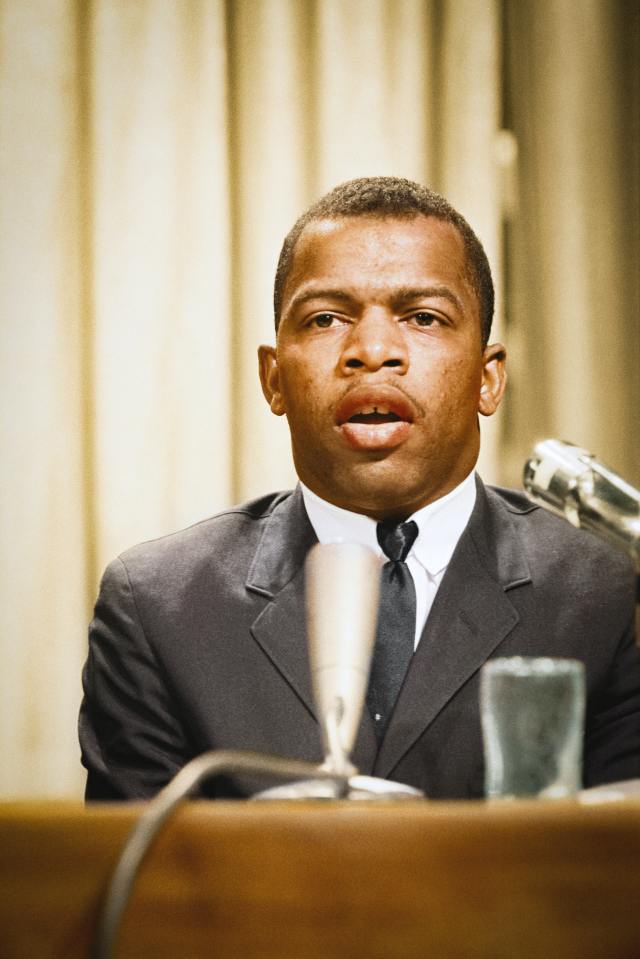
After writing about Rosa Parks last week, Rod Messick, CEO of Berkshire Hathaway HomeServices Homesale Realty, responded with a book recommendation: “His Truth Is Marching On: John Lewis and the Power of Home” by John Meacham.

John Lewis, as Rod explained, was known during the Civil Rights Movement as the “Boy from Troy.” Coincidentally, Rod grew up in Troy, Alabama and didn’t know about Lewis’ connection to his hometown until recently. Rod said he knew of John Lewis as a Civil Rights leader who was attacked on the bridge at Selma, as a congressman from Atlanta but not until the end of Lewis’ life did Rod realize that Lewis grew up mere miles from his own home.

“You see there was no civic pride in the ‘70s and ‘80s around being the home of John Lewis,” Rod told me. “We had a major thoroughfare named after George Wallace but no recognition of John Lewis.”

All that changed in 2020 after Troy University – a school that in 1957 denied John Lewis admission because of the color of his skin – named a building after Lewis.

Soon, the town of Troy began to learn about the amazing life of the human rights activist and advocate for non-violent change. Finally, John Lewis got the long-overdue recognition he deserved. It’s also worth noting that despite his initial rejection by Troy University, Lewis never held any spite or hatred for the school. He chose forgiveness, and even visited the Troy University campus in 1989 to receive an honorary doctorate. He returned in 2006, after Troy University awarded Lewis with the Hall-Waters Prize for his memoir, “Walking with the Wind.”

Gladys West is another Black leader whose legacy was brought to my attention by Helen Cocuzza of Berkshire Hathaway HomeServices Fox & Roach, REALTORS®. She shared with me that Gladys West developed the GPS technology most of us use daily today.

West was born in rural Virginia on October 27, 1930. As her Britannica biography notes: “In her community the only clear options for a young Black girl’s future were continuing to farm or working at a tobacco-processing plant.”

But West’s penchant for learning took her somewhere new, and after she graduated valedictorian of her high school, West was offered a full scholarship to Virginia State College. She graduated in 1952 with a degree in mathematics then received a master’s degree in mathematics. In 1956, the U.S. Naval Proving Ground hired West to work in the weapons laboratory in Dahlgren, Virginia. She was the fourth Black employee in the entire organization, and she quickly earned a reputation for solving complex mathematical problems by hand. Her work eventually led to a satellite that was programmed to create computer models of the Earth’s surface, and it’s this model (and subsequent updates) that allows GPS systems today to make accurate calculations of any location on the planet.

So, what’s the message? Like Mary W. Jackson, Gladys West was once a “hidden figure” of history, but the more we have these conversations about Black leaders like Jackson, like West, like Lewis, the more we can be sure their stories, contributions and legacies will never, ever be forgotten.

No more posts.